
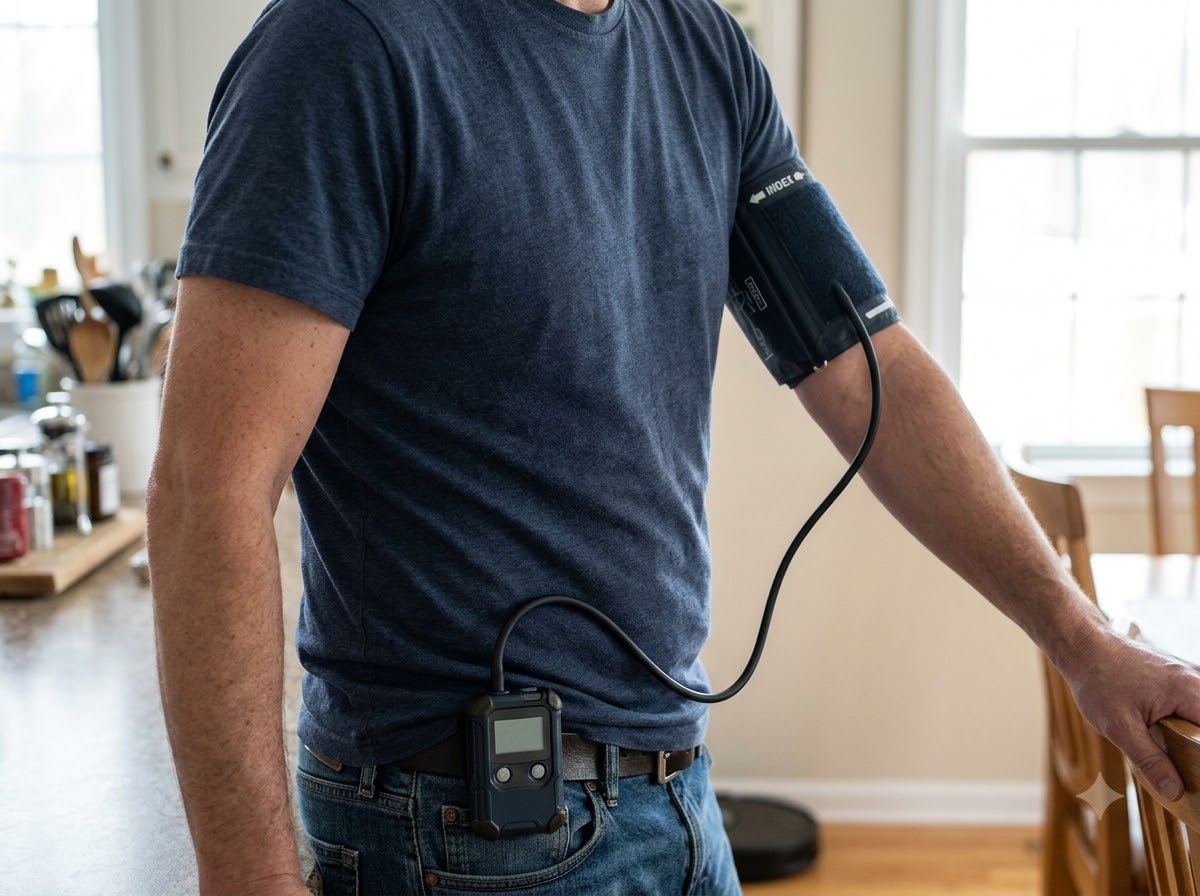
What is ABPM?
ABPM stands for ambulatory blood pressure monitoring. “Ambulatory” simply means “while you move about”. A BP cuff is wrapped on your upper arm and connected by a tube to a small device worn on your belt. For 24 hours, the device inflates the cuff on its own and records your blood pressure — at work, at home, while travelling and while you sleep.
At the end, the doctor gets 50 or more readings instead of one. The report shows your daytime BP, night-time BP, 24 hour average and how your BP rises and falls through the day. This blood pressure pattern tells far more than a single number.
Think of it like this: judging your BP from one clinic reading is like judging a cricketer from one ball. ABPM watches the whole innings — the good overs, the bad overs and the night session.
Why does my BP keep changing?
Blood pressure is meant to change. It goes up when you walk, climb stairs, feel tense, are in pain, drink tea or coffee, or eat salty food, and it comes down when you rest and sleep. Many people also get a higher reading just because they are anxious in front of a doctor. Because of this BP fluctuation, one or two readings can mislead — ABPM shows whether your BP is truly high on average, and when.
Who Needs ABPM?
Your doctor may advise a 24 hour BP test when clinic and home readings do not match, when BP stays high despite medicines, or when the decision to start lifelong BP medicines needs to be made carefully.
Situations where ABPM helps
Diagnosis of high BP
- First-time high BP, before starting long-term medicines
- Suspected white-coat hypertension (high only at the clinic)
- Suspected masked hypertension (normal at clinic, high otherwise)
- Young patients with high BP, to confirm before treatment
Checking treatment
- BP test for uncontrolled BP despite two or more medicines
- Checking whether BP medicines are working through the whole day
- Dizziness or weakness that may mean BP is dropping too low
- Diabetes, kidney disease or pregnancy-related BP, if advised
Very high BP with symptoms is an emergency. Severe headache, chest pain, breathlessness, blurred vision, confusion or weakness on one side of the body needs urgent care — not an ABPM appointment. Call +91 77778 65621 or come to our 24x7 emergency.
Can ABPM Detect High BP? What the Test Shows
Yes. ABPM is one of the most reliable ways to confirm high BP (hypertension). Along with the average, it finds patterns that a single reading cannot.
White-coat hypertension
BP is high only in the clinic because of nervousness, but normal the rest of the day. This avoids unnecessary medicines.
Masked hypertension
BP looks normal in the clinic but is high at work or at home. Without ABPM this hidden high BP is easily missed.
Night-time BP and non-dipping
Normally BP falls during sleep. If it does not fall (“non-dipping”) or rises at night, the heart and kidneys are under extra strain.
Is your medicine lasting all day?
Shows whether BP stays controlled for 24 hours or rises before the next dose, so timing or dose can be adjusted.
Uncontrolled or resistant BP
When BP stays high on several medicines, ABPM confirms it, and the doctor may look for hidden causes such as narrowed kidney arteries.
Renal artery diseaseBP dropping too low
Episodes of low BP, matched with dizziness or weakness noted in your diary, which may need a change in medicines.
What ABPM cannot tell: it measures blood pressure only. It does not show whether high BP has already affected the heart. For that your doctor may add an ECG or a 2D Echo to look for thickening or weakness of the heart muscle.
How Does Ambulatory BP Monitoring Work?
How long is an ABPM test? The recording runs for 24 hours. Fitting the cuff takes about 15–20 minutes, and you return the device the next day.
The cuff and device are fitted
A BP cuff is placed on your upper arm (usually the non-writing arm) and connected by a tube to a small device on your belt or in a pouch.
A test reading is taken
Our staff take a first reading in the clinic to make sure the cuff fits well and the device is working.
Automatic readings all day and night
The cuff inflates on its own every 15–30 minutes in the daytime and every 30–60 minutes at night. Each reading takes less than a minute.
Keep the arm still during a reading
When you feel the cuff tighten, stop moving if you can, let the arm hang relaxed by your side and do not talk until it loosens.
Write a simple diary
Note the time you sleep and wake, take medicines, and any symptom like dizziness or headache. Follow your normal routine.
Return the device and get the report
After 24 hours the cuff is removed and the readings are downloaded. Your doctor will tell you when the report will be ready and explain it.
Keep to a normal working day. The test is most useful when it records a usual day — your normal travel, work and sleep — not a holiday spent resting at home.
How to Prepare for a 24 Hour BP Test
Little preparation is needed. A few simple steps make sure the readings are accurate and the day is comfortable.
Good to do
- Take a bath before you come — you cannot bathe with the device on
- Wear a loose shirt or top with sleeves that fit over the cuff
- Take your BP medicines at the usual time, unless your doctor says otherwise
- Bring your list of medicines and home BP readings, if any
- Keep the device beside you or under the pillow at night
Avoid during the 24 hours
- Bathing, showering or swimming — keep the device dry
- Removing the cuff or letting it slip down the arm
- Gym or heavy exercise — readings may fail
- Moving or talking while a reading is being taken
- Long driving, if possible — the cuff may inflate at the wheel
Is ABPM painful or risky?
No. ABPM is safe and there are no needles. You feel the same squeeze as a normal BP check, many times over the day. Some people feel a little sleep disturbance when the cuff inflates at night, and the arm may feel slightly sore or show light marks under the cuff for a short time. Tell us if the arm becomes very painful, swollen or numb.
Is ABPM Better Than One BP Reading?
For diagnosing high BP and checking treatment, yes — ABPM gives a far more complete answer than a single clinic reading. Here is how they compare.
| One clinic BP reading | ABPM (24 hour BP) | |
|---|---|---|
| Number of readings | 1 to 3 | Around 50 or more |
| Where measured | In the clinic, often while anxious | At home and work, in daily life |
| Night-time BP | Not measured | Measured while you sleep |
| White-coat effect | Can make BP look high | Identified and separated |
| Masked hypertension | Usually missed | Detected |
| Medicine effect over the day | Not known | Seen hour by hour |
| Time needed | A few minutes | 24 hours, with a return visit |
Both have a place: clinic and home BP checks are still important for regular follow-up. ABPM is used when an accurate full-day picture is needed to diagnose or adjust treatment.
What Happens After Your ABPM Report?
The report gives your daytime average, night-time average and 24 hour average, the share of readings that were high, and whether your BP falls normally at night. As a general guide, many doctors take a daytime average of 135/85 or more, or a night-time average of 120/70 or more, as high. Our cardiologist then explains what it means for you:
- Normal average BP: if the clinic reading was high, this may be white-coat hypertension — usually lifestyle advice and regular checks, not new medicines.
- High average or high night-time BP: treatment is started or adjusted — dose, timing or the choice of medicine.
- BP high despite medicines, or dropping too low: medicines are changed, and tests for the heart, kidneys or hidden causes may be advised.
Tip: keep your ABPM report with your home BP log. Comparing the two helps your doctor know how much to trust your home readings in future.
Why Get ABPM at Prathmesh Cardiac Institute?
The value of ABPM lies in how the readings are interpreted and turned into a clear treatment plan.
Read by a DM cardiologist
Your BP pattern is interpreted by a heart specialist along with your history and medicines.
Correct cuff fitting
The right cuff size and a test reading at fitting help make the 24 hour data accurate.
Clear advice on medicines
The report is used to decide the dose and timing of BP medicines, not just filed away.
Next test under one roof
ECG, 2D Echo, Holter and TMT are available here if high BP needs a heart check.
24x7 emergency backup
Our cardiac emergency, cath lab and CCU are in the same building.
Easy to reach in Raipur
NH-30, Amlidih Road, Deopuri — convenient for patients from Raipur and nearby districts.
Who Reads Your Report
Your report is studied by a DM Cardiology specialist, who explains it to you in plain words and tells you what to do next.
800 × 1000 px · JPG

Dr. Gaurav Tripathi
Treats heart attacks and blocked arteries, and reviews BP control in patients with heart disease.
800 × 1000 px · JPG

Dr. Sulabh Chandrakar
Sees patients with high BP and long-term heart problems, and adjusts BP medicines based on the ABPM pattern.
ABPM — Questions Patients Ask Us
ABPM (ambulatory blood pressure monitoring) is a test in which a BP cuff on your arm, connected to a small device on your belt, automatically measures your blood pressure many times over 24 hours while you follow your normal routine.
It is done to confirm whether you really have high BP, to find white-coat or masked hypertension, to check night-time BP and to see whether your BP medicines are working through the whole day.
People whose clinic and home readings do not match, people with fluctuating BP, those whose BP stays high despite medicines, those who feel dizzy on BP medicines, and patients in whom the doctor wants to confirm high BP before starting lifelong treatment.
The device inflates the cuff automatically every 15–30 minutes during the day and every 30–60 minutes at night, and stores each reading. You keep your arm still during each reading and note sleep, medicine times and symptoms in a diary.
BP normally rises with activity, stress, pain, tea or coffee and salty food, and falls with rest and sleep. Anxiety at the clinic can also raise it. That is why ABPM, which looks at the whole day, is more reliable than one reading.
Yes. ABPM is one of the most reliable ways to diagnose high BP, because it uses the average of many readings. It can also detect hidden high BP that a clinic reading misses, and high BP that occurs only at night.
The recording lasts 24 hours. Fitting the device takes about 15–20 minutes, and you come back the next day to return it.
For diagnosing high BP and checking treatment, yes. A single reading can be raised by nervousness or missed by chance, while ABPM gives the true average over day and night. Regular clinic and home checks are still useful for follow-up.
It is when BP is high in the clinic, usually due to nervousness, but normal during the rest of the day. ABPM helps identify it so that you are not started on medicines you may not need, though regular checks are still advised.
Yes. You should follow your normal work and sleep routine. The cuff may wake you briefly at night. Avoid bathing and heavy exercise, and keep the arm still whenever a reading is being taken.