
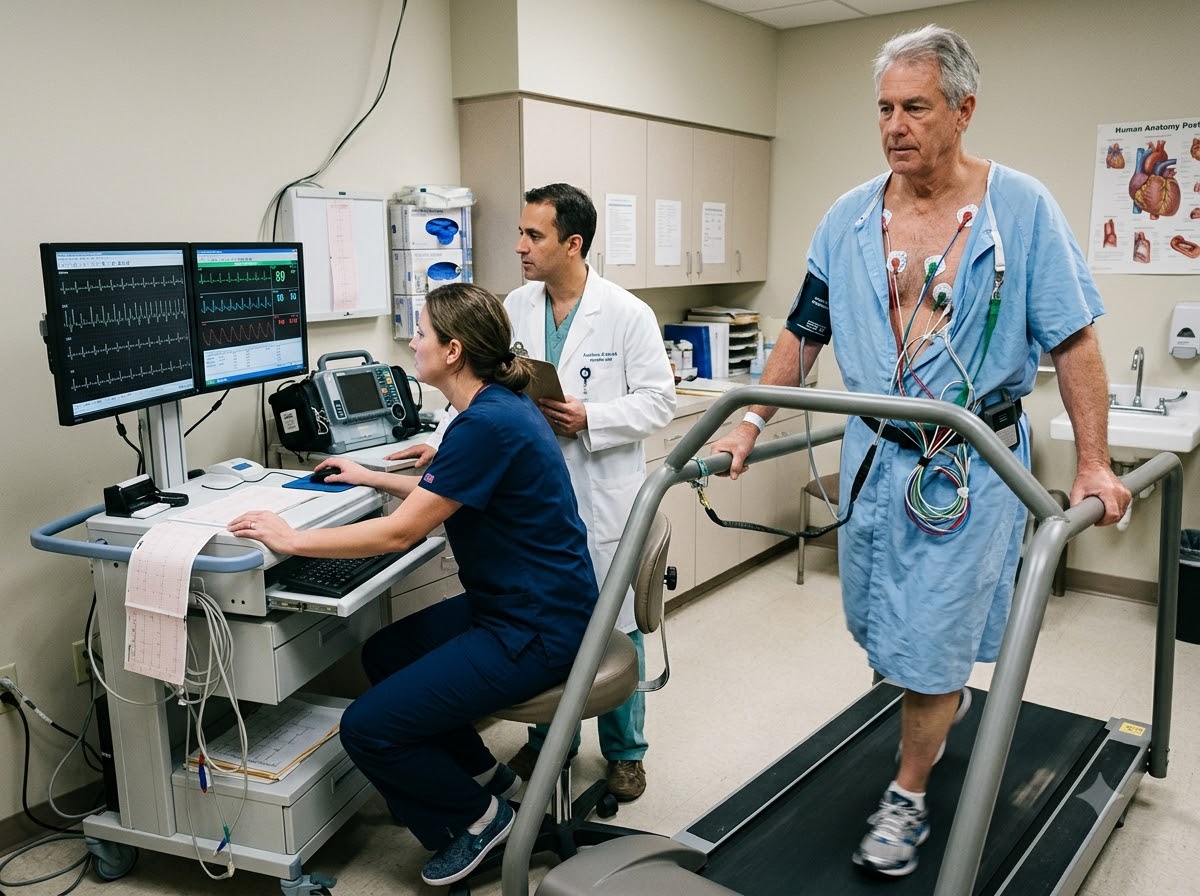
What is a TMT Test?
A TMT test — treadmill test, also called an exercise stress test or exercise ECG — records your ECG while you walk on a treadmill. At rest, a heart with a partly blocked artery often gets enough blood, so the resting ECG can look normal. During exercise the heart needs more blood. If an artery is narrowed, the ECG may change, or you may feel chest pain or unusual breathlessness.
Throughout the test your heart rate, ECG and blood pressure are monitored, and a doctor watches how your heart responds to exercise. It is one of the most common cardiac stress tests and is often the next step after a normal ECG.
Think of it like this: a car with a blocked fuel pipe may run fine while idling but splutter on a steep road. The TMT takes your heart “up the hill” in a safe, watched setting to see how it behaves under load.
Why is TMT done?
Mainly to find out whether symptoms that come on with effort — chest pain, heaviness, breathlessness — are due to reduced blood supply to the heart (ischemia). It is also done to check how much exercise is safe after a heart attack or angioplasty, to look for rhythm problems that come only during exercise, and to see how BP rises with effort.
Who Needs a TMT?
A TMT is advised when your symptoms come on with effort and settle with rest, or when your doctor wants to check the heart’s response to exercise before planning treatment.
Symptoms where a TMT helps
TMT for chest pain and heart symptoms
- Chest pain or discomfort that comes with effort and settles with rest
- Breathlessness on walking that has no clear lung cause
- Heart test after chest pain when the resting ECG is normal
- Follow-up after a heart attack, angioplasty or bypass, as advised
TMT for heart checkup
- Diabetes, high BP, high cholesterol or smoking, especially above 40
- Strong family history of early heart disease
- Before starting a heavy exercise or sports programme
- Job or medical fitness checks that ask for it
Chest pain right now is not a TMT case. Pain at rest, pain lasting more than a few minutes, or pain with sweating needs an ECG and emergency care at once — not a treadmill. Call +91 77778 65621 or come to our 24x7 emergency.
What Does a Treadmill Test Detect?
Can TMT detect heart problems? Yes — especially problems that show up only when the heart is working hard.
Reduced blood supply (ischemia)
ECG changes during exercise that suggest a narrowed heart artery.
Heart blockageCause of effort chest pain
Whether chest pain or heaviness on walking matches changes in the heart, or is likely from another cause.
Rhythm problems on exercise
Extra beats or fast rhythms that appear only when the heart rate rises.
Arrhythmia careBlood pressure response
BP that rises too much, or fails to rise, with exercise — both give the doctor useful clues.
Exercise capacity
How long and how hard you can walk, which reflects overall heart fitness and helps plan safe activity.
Recovery after treatment
How the heart copes after a heart attack, angioplasty or bypass, to guide rehabilitation.
Heart attack careWhat a TMT cannot tell: it shows signs of reduced blood flow, not a picture of the arteries. It can sometimes give a positive result when arteries are normal, and a negative result does not rule out every blockage. It also does not show valves or pumping strength — for that a 2D Echo is used, and a Stress Echo may be advised if the TMT is unclear.
How is a TMT Done?
How long does a TMT take? The whole visit usually takes 30 to 45 minutes including preparation. The actual walking is usually only a few minutes up to about 15, depending on your fitness.
Check-up before you start
The doctor asks about your symptoms and medicines, checks your BP and a resting ECG, and makes sure the test is safe for you today.
ECG stickers and BP cuff
Stickers are placed on your chest and connected to the ECG monitor. A BP cuff is put on your arm.
Walking in stages (Bruce protocol)
You start walking slowly. Every 3 minutes the treadmill becomes a little faster and a little steeper. Your ECG is watched all the time and BP is checked at each stage.
You can stop at any time
Tell the team at once if you feel chest pain, severe breathlessness, dizziness or leg pain. The doctor also stops the test if the ECG or BP changes, or when you reach your target heart rate.
Rest and recovery
You sit or lie down for several minutes while the ECG and BP are recorded as your heart slows down. The doctor then explains the result.
The goal is not to run as fast as possible. The aim is to raise your heart rate to a target based on your age. Walking as long as you comfortably can gives the most useful result.
What Should I Do Before a TMT?
A little preparation makes the TMT safer and the result more reliable.
Good to do
- Eat a light meal 2–3 hours before the test
- Wear comfortable walking shoes and loose clothes
- Bring your medicine list and old ECG, Echo and TMT reports
- Ask your doctor in advance whether to stop beta-blockers or other heart-rate medicines before the test
Better to avoid
- A heavy meal just before the test
- Smoking, tea, coffee or energy drinks for a few hours before
- Stopping any medicine on your own without asking the doctor
- Body oil or lotion on the chest, or slippers and sandals
Is TMT Safe?
For most people, yes. The test is carefully supervised and stopped as soon as there is a warning sign. Because the heart is being made to work hard, there is a small risk — such as chest pain, a drop in BP, an abnormal heart rhythm or, very rarely, a heart attack. That is why a doctor is present throughout and emergency medicines and equipment are kept ready, with our CCU in the same building.
A TMT is not done (or is postponed) if you have:
- Chest pain at rest, or chest pain that has recently become worse or more frequent (unstable chest pain)
- A heart attack in the last few days
- Severe aortic stenosis (a tight heart valve)
- Uncontrolled high BP, an uncontrolled irregular heartbeat, or active heart failure
- Fever, an acute illness, or a recent blood clot in the legs or lungs
If you cannot walk well because of knee, hip or back problems, tell us — a Stress Echo with medicine may suit you better.
TMT vs Stress Echo — Which One Do I Need?
Both are cardiac stress tests. The difference is in what the doctor watches while your heart works hard.
| TMT (treadmill test) | Stress Echo | |
|---|---|---|
| What is watched | ECG, BP and symptoms during exercise | Ultrasound pictures of the heart walls moving, plus ECG and BP |
| How the heart is stressed | Walking on a treadmill | Treadmill exercise, or a medicine if you cannot walk |
| Detail | Shows whether there are signs of reduced blood flow | Shows which part of the heart is not getting enough blood |
| Reliability | A good first test, but can sometimes give a false positive | Usually gives a clearer answer when the TMT is doubtful |
| Best when | Resting ECG is normal and you can walk well | Resting ECG is abnormal, TMT was unclear, or walking is difficult |
| Time | About 30–45 minutes | Usually longer, as scans are taken before and after stress |
You do not have to choose. Your cardiologist decides which test fits you. Many patients start with a TMT; if the answer is not clear, a Stress Echo is the next step.
Understanding Your TMT Result
The result is read together with your symptoms, risk factors and how long you walked — never the treadmill graph alone.
- Negative (normal) TMT: no worrying ECG changes even after reaching your target heart rate. A significant blockage is less likely, though not completely ruled out. The doctor advises on medicines, lifestyle and follow-up.
- Positive TMT: the ECG showed changes that suggest reduced blood flow during exercise. It does not by itself prove a blockage. The doctor may advise a Stress Echo, CT coronary angiography or coronary angiography to confirm.
- Inconclusive TMT: you could not reach the target heart rate, or the ECG was hard to read. Another type of test is usually chosen.
Tip: a TMT result is a guide, not a final verdict. If your symptoms continue even after a normal TMT, tell your doctor — further testing may still be needed.
Why Get Your TMT Test at Prathmesh Cardiac Institute?
A stress test should be done where a heart problem can be handled immediately if it appears. Here, the TMT room is part of a full cardiac hospital.
Supervised by a cardiologist
A doctor watches your ECG, BP and symptoms through every stage of the test.
Safety check before you walk
Your history, BP and resting ECG are checked first, so the test is done only when it is safe.
Result explained in plain words
You are told what a positive, negative or unclear result means for you.
Next test under one roof
Stress Echo, 2D Echo, Holter and angiography are available here if more information is needed.
24x7 CCU and cath lab
If anything unexpected happens during the test, emergency heart care is in the same building.
Easy to reach in Raipur
NH-30, Amlidih Road, Deopuri — convenient for patients from Raipur and nearby districts.
Who Reads Your Report
Your report is studied by a DM Cardiology specialist, who explains it to you in plain words and tells you what to do next.
800 × 1000 px · JPG

Dr. Gaurav Tripathi
Interprets TMT results for patients with effort chest pain and plans angiography or angioplasty when needed.
800 × 1000 px · JPG

Dr. Sulabh Chandrakar
Sees patients with BP, diabetes and chest symptoms, and explains what a TMT result means for their treatment.
TMT Test — Questions Patients Ask Us
A TMT (treadmill test) is an exercise stress test in which you walk on a treadmill while your ECG, heart rate and BP are monitored. It shows how your heart responds when it has to work harder.
It is done mainly to check whether chest pain or breathlessness on effort is due to reduced blood supply to the heart. It is also used to check fitness after a heart attack or angioplasty and to look for rhythm or BP problems during exercise.
It can detect signs of reduced blood flow to the heart (ischemia), rhythm problems that come on with exercise, an abnormal BP response and your exercise capacity. It does not show the arteries directly.
People with chest pain, heaviness or breathlessness that comes on with effort, people with diabetes, high BP, smoking or family history of heart disease who need a heart checkup, and patients after a heart attack or angioplasty when the doctor advises it.
For most people, yes, because it is supervised by a doctor and stopped at the first warning sign. There is a small risk of chest pain, a drop in BP or an abnormal rhythm, and very rarely a heart attack, so emergency care is kept ready. It is not done in people with unstable chest pain, severe aortic stenosis or uncontrolled BP.
The whole visit usually takes 30 to 45 minutes including preparation and recovery. The walking part is usually a few minutes up to about 15, depending on your fitness.
Eat a light meal 2–3 hours before, wear comfortable walking shoes, avoid smoking and coffee for a few hours, and bring your medicine list. Ask your doctor in advance whether to stop beta-blockers — never stop medicines on your own.
Yes, it can detect signs of blockage in the heart arteries and rhythm problems that appear only during exercise. But it can sometimes be falsely positive or miss a blockage, so your doctor may advise a Stress Echo or angiography for a clearer answer.
A positive TMT means the ECG showed changes during exercise that suggest the heart was not getting enough blood. It is a warning sign, not a final diagnosis — your cardiologist will usually advise a confirming test before deciding on treatment.
A TMT watches the ECG during exercise, while a Stress Echo also takes ultrasound pictures of the heart before and after stress. A Stress Echo gives more detail and is preferred when the resting ECG is abnormal, the TMT is unclear or you cannot walk well.