
What is Holter Monitoring?
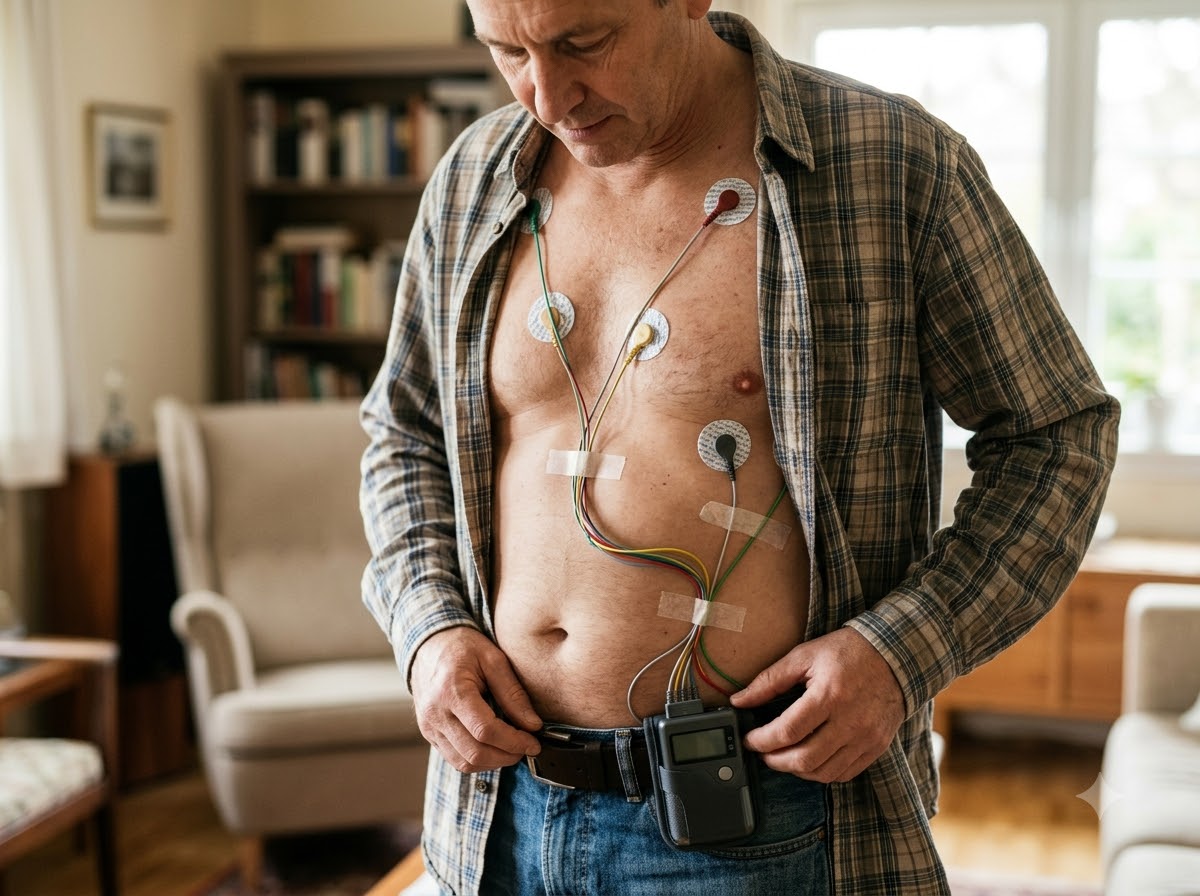
Holter monitoring is a 24 hour ECG recording. A few small stickers (electrodes) are placed on your chest and connected by thin wires to a recorder about the size of a mobile phone, which you keep on a belt or in a pouch. Then you go home and live your normal day. The recorder quietly stores every single heartbeat — around one lakh beats in 24 hours.
Doctors also call it an ambulatory ECG or continuous ECG monitoring, because it keeps recording while you walk, work, eat and sleep. When you return the device, the full recording is analysed and checked by a cardiologist for any change in your cardiac rhythm.
Think of it like this: a normal ECG is a photograph of your heart rhythm, taken in 10 seconds. A Holter is a CCTV recording of the whole day and night. If the problem happens only now and then, the photograph may miss it, but the CCTV will usually catch it.
Why is a Holter test done?
Many rhythm problems do not stay all the time. Palpitations may come for a few minutes in the evening, or dizziness may happen once a day. By the time you reach the clinic, the ECG is often normal. A Holter test is done to catch the heart rhythm at the exact moment you feel the symptom, so the doctor can see whether the heart is the cause or not. It is also used to check how well rhythm medicines or a pacemaker are working.
Who Needs Holter Monitoring?
Your cardiologist may advise Holter monitoring when you have symptoms that come and go, or when an ECG shows an occasional abnormal beat that needs a longer look.
Symptoms where a Holter test helps
Common reasons to get a Holter
- Test for intermittent palpitations that a normal ECG has missed
- Holter for dizziness or fainting with no clear cause
- Irregular heartbeat test when atrial fibrillation (AF) is suspected
- Very slow pulse, or pauses seen on an ECG
Follow-up and monitoring
- Checking how well rhythm-control medicines are working
- After a heart attack, to look for risky rhythms
- Checking pacemaker function, if your doctor advises
- Stroke patients, to look for hidden AF
Do not wait for a Holter if symptoms are severe. Fainting with injury, chest pain, a very fast heartbeat that does not settle, or severe breathlessness needs emergency care. Call +91 77778 65621 or come to our 24x7 emergency.
Can Holter Detect Irregular Heartbeat and Palpitations?
Yes — that is exactly what it is designed for. Because it records your heart rhythm for a full day and night, Holter monitoring can pick up rhythm problems that appear only for a short time.
Atrial fibrillation (AF)
An irregular, often fast heartbeat that may come in episodes. AF needs treatment because it raises the risk of stroke.
Arrhythmia careFast heartbeat episodes
Sudden fast rhythms such as SVT that start and stop on their own, often felt as palpitations.
Fast heartbeat treatmentPauses and slow heartbeat
Long gaps between beats or a very slow pulse, often during sleep, which may explain dizziness or fainting.
Heart block
When the electrical signal is delayed or blocked on its way through the heart. Some patients may need a pacemaker.
Extra or skipped beats
Ectopic beats are counted over 24 hours, so the doctor knows whether they are few and harmless or frequent.
Cause of dizziness or fainting
By matching your diary with the recording, the doctor can tell whether your symptoms come from the heart rhythm.
What a Holter cannot tell: if no symptom happens during the 24 or 48 hours, the recording may be normal even if a problem exists. It also does not show the heart valves or pumping strength — for that you need a 2D Echo. If symptoms are rare, your doctor may advise longer rhythm monitoring.
What Happens During Holter Monitoring?
How long is a Holter monitor worn? Usually 24 hours, sometimes 48 hours or longer if your doctor wants a longer look. Fitting the device takes about 15–20 minutes, then you go home.
Stickers are placed on the chest
A few electrodes (usually 3 to 7) are stuck on your chest. If there is hair, a small patch may be cleaned or shaved so the stickers hold well.
The recorder is connected
Thin wires join the stickers to a small recorder that clips on your belt or hangs in a pouch under your shirt.
You get a symptom diary
Our staff explain how to write down the time and type of any symptom — palpitations, dizziness, chest discomfort — and what you were doing.
You live a normal day and night
Go to work, walk, eat and sleep as usual. Do the activities that normally bring on your symptoms, unless your doctor says otherwise. Do not bathe while wearing it.
Return the device next day
After 24 (or 48) hours you come back. The stickers are removed and the recording is downloaded from the recorder.
Analysis and report
Software scans every beat, and a cardiologist checks the important parts against your diary. Your doctor will tell you when the report will be ready and explain it to you.
Your diary is as important as the recording. If you write “7:40 pm — heart racing while climbing stairs”, the doctor can look at exactly that minute of the recording and see what your heart was doing.
How to Prepare for a Holter Test
Preparation is simple. Because you cannot bathe while wearing the recorder, plan your bath and clothes in advance.
Good to do
- Take a bath just before you come for fitting
- Wear a loose shirt or top that opens from the front
- Take your usual medicines unless the doctor says otherwise
- Bring your old ECG reports and a list of medicines
- Keep a pen handy to fill the symptom diary
Avoid while wearing the Holter
- Bathing, showering or swimming — the recorder must stay dry
- Body oil, lotion or powder on the chest
- Pulling the wires or removing the stickers
- Electric blankets, heating pads and strong magnets
- X-ray, MRI or other scans during the recording, unless discussed with us
Is Holter monitoring painful?
No. Holter monitoring is completely painless. There are no needles and no current — the recorder only listens to your heart. Some people find the stickers a little itchy, or feel a slight pull when they are removed. Sleeping with the recorder may feel a bit odd for the first night, but most people manage easily. It is safe for children, elderly patients and pregnant women.
Holter vs Normal ECG — What is the Difference?
Both tests record the heart’s electrical activity. The difference is how long they record, and therefore what they can catch.
| Normal ECG | Holter monitoring | |
|---|---|---|
| Recording time | About 10 seconds | 24 hours, sometimes 48 or more |
| Where it is done | Lying down in the clinic | At home, during your normal routine |
| What it catches | Rhythm at that moment only | Rhythm problems that come and go |
| During sleep | Not recorded | Recorded, including night-time pauses |
| Linked to symptoms | Only if symptom happens during the test | Yes — matched with your diary |
| Best for | Chest pain, first heart checkup | Palpitations, dizziness, fainting, suspected AF |
| Report | Immediately | After the device is returned and analysed |
They work together: most patients get an ECG first. If it is normal but symptoms keep coming back, the Holter is the natural next step.
What Happens After Your Holter Report?
The report shows your lowest, highest and average heart rate, the number of extra beats, any pauses or abnormal rhythms, and what your heart was doing when you felt symptoms. Our cardiologist reads it together with your history and other tests. Usually one of these follows:
- Normal rhythm during your symptoms: reassuring — the heart rhythm is unlikely to be the cause, and the doctor looks at other reasons.
- Harmless extra beats or minor findings: lifestyle advice (sleep, tea, coffee, stress) and sometimes a simple medicine.
- A significant rhythm problem: such as AF, heart block or long pauses — treatment is planned, which may include medicines, blood thinners or a pacemaker.
Tip: if you felt no symptoms during the recording, tell the doctor. A normal Holter without symptoms does not always end the search — a repeat or longer monitoring may be advised.
Why Get Holter Monitoring at Prathmesh Cardiac Institute?
A Holter recording is long and detailed. What matters is careful reading and a clear plan afterwards.
Checked by a DM cardiologist
Software findings are reviewed by a heart specialist, not left to the machine alone.
Diary matched with recording
Your symptoms are compared minute by minute with your heart rhythm.
Clear instructions at fitting
Our staff explain what to do and what to avoid, so the recording is clean and useful.
Next test under one roof
ECG, 2D Echo, TMT and ABPM are all available here if more information is needed.
Treatment if needed
If a serious rhythm problem is found, our cath lab and CCU are in the same building.
Easy to reach in Raipur
NH-30, Amlidih Road, Deopuri — convenient for patients from Raipur and nearby districts.
Who Reads Your Report
Your report is studied by a DM Cardiology specialist, who explains it to you in plain words and tells you what to do next.
800 × 1000 px · JPG

Dr. Gaurav Tripathi
Treats heart attacks and rhythm emergencies, and plans pacemaker and cath lab care when a Holter shows a serious problem.
800 × 1000 px · JPG

Dr. Sulabh Chandrakar
Sees patients with palpitations, dizziness and fainting, and explains Holter findings in simple words.
Holter Monitoring — Questions Patients Ask Us
Holter monitoring is a 24 hour ECG recording done with a small recorder that you wear at home. It stores every heartbeat while you go about your normal day and night, so the doctor can see rhythm problems that a short ECG may miss.
A Holter test is done to find out whether symptoms like palpitations, dizziness or fainting are caused by a heart rhythm problem. It is also used to check how well rhythm medicines or a pacemaker are working.
People with palpitations, skipped beats, dizziness or fainting that come and go, people with a suspected irregular heartbeat such as AF, and some patients after a heart attack or stroke. Your cardiologist will decide if you need it.
Usually for 24 hours. Sometimes the doctor asks for 48 hours or longer, especially when symptoms are less frequent. You return the device the next day.
Yes. Holter monitoring can detect atrial fibrillation, extra beats, fast rhythms, slow rhythms, pauses and heart block, as long as they happen during the recording.
Yes. When you feel palpitations, you note the time in your diary, and the doctor checks exactly what your heart was doing at that moment. This shows whether the palpitations come from a rhythm problem or not.
Small stickers are placed on your chest and connected to a recorder on your belt. You go home, follow your normal routine, sleep with it and write down any symptoms. The next day you return it and the recording is analysed.
No. It is painless, with no needles and no current. The stickers may itch slightly or pull a little when removed, and sleeping with the recorder takes a little getting used to.
No. The recorder must not get wet, so you cannot bathe, shower or swim while wearing it. Take a bath just before your appointment, and you can bathe again after the device is removed.
A normal ECG records your heart for about 10 seconds in the clinic, while a Holter records it continuously for 24 hours or more at home. That is why a Holter can catch rhythm problems that come and go.