

Who We Are
Prathmesh Cardiac Institute is the dedicated cardiac unit of Prathmesh Hospital, on NH-30 at Deopuri, Raipur. It was founded by two cardiologists who had both already been practising in this region — Dr. Gaurav Tripathi and Dr. Sulabh Chandrakar — around a single idea: that a patient from Chhattisgarh should not have to travel to Nagpur, Delhi or Mumbai for heart care that can be delivered just as well here.
That matters more in cardiology than in almost any other speciality. In a heart attack, the muscle that dies during a four-hour journey does not come back. So the institute was built to do the complete range of cardiac work in one place — from an ECG and an echo, through angiography and complex angioplasty, to pacemakers and device implants — with the equipment and the seniority that those procedures actually demand.
What we try to be honest about. Not every blockage needs a stent, not every valve needs replacing, and not every patient who walks in needs a procedure at all. A large part of what a cardiac centre owes its patients is telling them when the answer is medicines and follow-up. If you are advised a procedure here, you will be told which specific finding makes it necessary — and it is entirely reasonable to ask.
Our Facilities and Technology
Equipment is the part of a hospital that patients can least judge for themselves, so here is plainly what is installed and what each thing is for.
Advanced Cath Lab with 3D Angiography
The room where angiography, angioplasty, pacemaker and device procedures are done. 3D imaging lets the artery be seen from several angles, which matters most in complex and calcified blockages.
IVUS and FFR
IVUS gives a picture from inside the artery, and FFR measures the actual pressure drop across a narrowing. Together they answer the question that a plain angiogram cannot always answer — whether a stent is genuinely needed, and what size it should be.
Rotablation (Rota) and IVL
For blockages so hardened with calcium that a balloon cannot pass. These techniques prepare the artery so that treatment is possible at all, rather than sending the patient elsewhere.
Fully Equipped CCU
A monitored cardiac intensive care unit. The first 48 hours after a heart attack carry the highest risk of rhythm problems, and that is precisely when continuous monitoring counts.
Non-Invasive Cardiology
ECG, 2D echocardiography, stress and contrast echo, TMT, Holter monitoring, colour Doppler and 24-hour BP monitoring — the tests that settle most questions before anything invasive is considered.
On-Call Cath Lab Team 24x7
A heart attack at 2 AM gets the same response as one at 2 PM. The team is called in while the patient is still on the way.
The Doctors Who Will Treat You
In cardiology the operator matters as much as the equipment. Both of our consultants hold a DM in Cardiology — the highest specialist qualification in the field in India — and both perform their own procedures rather than delegating them.
800 × 1000 px · JPG
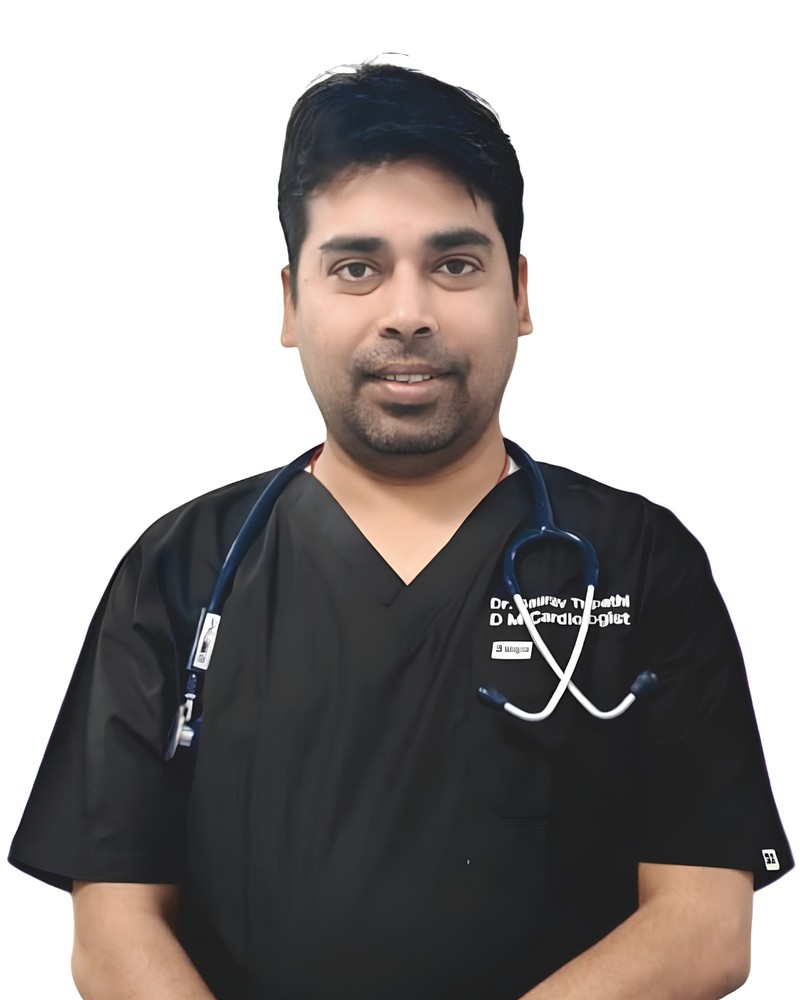
Dr. Gaurav Tripathi
Dr. Gaurav Tripathi is an interventional cardiologist based in Raipur. He completed his DM in Cardiology at the G.B. Pant Institute in New Delhi, one of the country’s best-known cardiac training centres, after an MD in General Medicine at RIMS Ranchi in which he was a gold medalist.
Before Prathmesh, he established the cardiology department at Suyash Hospital, Raipur. He works routinely on the complex end of coronary intervention — CTO (arteries that have been completely closed for a long time), bifurcation lesions, and heavily calcified stenosis — and uses IVL, Rotablation and IVUS as part of that work. He also has a particular interest in structural intervention and electrophysiology (EPS). He has performed thousands of procedures in Raipur.
Education and Training
- MBBSShyam Shah Medical College, Rewa, Madhya Pradesh — with a Roll of Honours in several subjects
- MD (General Medicine)Rajendra Institute of Medical Sciences (RIMS), Ranchi — Gold Medalist
- DM (Cardiology)Govind Ballabh Pant Institute of Postgraduate Medical Education and Research, New Delhi
- FSCAISociety of Cardiovascular Angiography and Interventions, USA
- FESCFellowship of the European Society of Cardiology
Areas of Practice
- Complex coronary angioplasty — CTO, bifurcation, calcified lesions
- Emergency and primary angioplasty during a heart attack
- IVUS, FFR and IVL guided intervention
- Rotablation for calcified arteries
- Peripheral and renal artery intervention
- Structural intervention and EPS
Memberships and Recognition
Lifetime member of the Cardiological Society of India (CSI), the American College of Cardiology (ACC), the European Society of Cardiology (ESC) and the Association of Physicians of India (API). He has lectured at national and international forums and has three international publications.
Approach to Patients. His stated approach is to partner with patients by empowering them with knowledge, so they can follow and track their own disease management rather than simply being handed a prescription.
800 × 1000 px · JPG
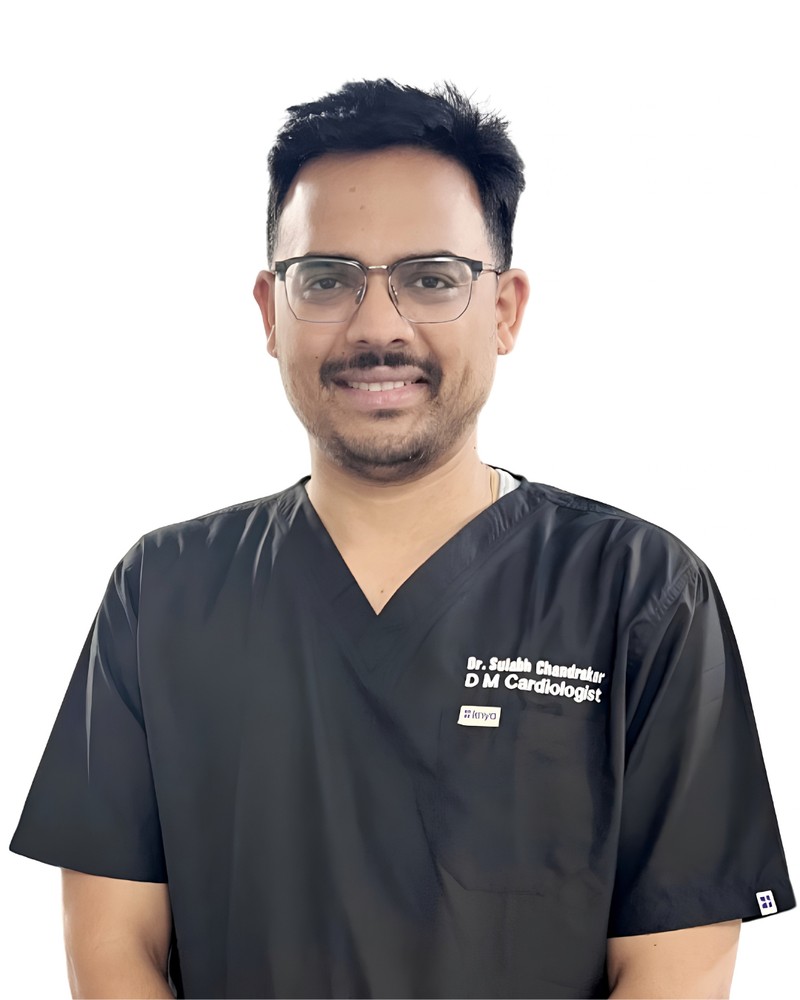
Dr. Sulabh Chandrakar
Dr. Sulabh Chandrakar is a certified interventional cardiologist whose training runs through three of India’s well-regarded institutions — MBBS at Pt. Jawaharlal Nehru Memorial Medical College here in Raipur, MD in General Medicine at LTM Medical College in Sion, Mumbai, and DM in Cardiology at Dr. Ram Manohar Lohia Hospital, New Delhi.
He describes his own work as combining clinical excellence, current technology and clear communication, and that shows in how his consultations run: time spent understanding what the patient is actually worried about, the diagnosis and the options explained in language the family can follow, and a plan built around the patient’s circumstances rather than a standard template.
Education and Training
- MBBSPt. Jawaharlal Nehru Memorial Medical College, Raipur
- MD (General Medicine)Lokmanya Tilak Municipal Medical College (LTMMC), Sion, Mumbai
- DM (Cardiology)Dr. Ram Manohar Lohia Hospital, New Delhi
Areas of Practice
- Coronary angiography and elective angioplasty (PCI)
- Primary angioplasty in acute heart attack
- Complex coronary interventions
- IVUS, OCT, FFR and iFR guided assessment
- Pacemaker implantation and device closure procedures
- Peripheral vascular intervention and TAVR
Memberships and Recognition
His practice covers coronary artery disease, heart attack, heart failure, hypertension, valvular heart disease, cardiac emergencies, preventive cardiology and peripheral vascular disease.
Approach to Patients. He holds that every patient deserves personalised attention and transparent communication — his emphasis is on trust, empathy, evidence-based medicine and long-term cardiovascular wellness rather than one-off intervention.
What We Treat
Each of these has a page of its own, written in plain language, explaining what the condition is, how it is found and what treatment is actually needed.
What Families Tell Us Matters
Your consultant does your procedure
The angiography or angioplasty is performed by the senior DM Cardiology consultant, including at night, not handed to junior staff.
A second opinion is welcome, not resented
If you arrive with reports from elsewhere, you will get a straight reading of them. If the earlier advice was right, we will say so.
Everything under one roof
Tests, procedure and follow-up in one building, instead of running between a diagnostic lab, a clinic and a hospital.
The family is told what is happening
Someone explains, in plain language, what is wrong and why a treatment is being advised, before consent is taken.
Close to home in Raipur
Follow-up after a cardiac procedure runs for years. Having it locally is what makes patients actually keep coming back.
Schemes and insurance handled
Government health schemes and most insurance policies cover cardiac procedures. Our team gives a written estimate first and helps with the paperwork.
Visiting Us
The institute is on NH-30 at Deopuri, easy to reach from the city and from the highway, which matters when someone is being brought in urgently.
Questions Families Ask Before Choosing
Three things, in this order. First, who actually performs the procedure — ask whether the DM Cardiology consultant does it himself, including at night. Second, what is in the cath lab — 3D angiography with IVUS and FFR allows a far more accurate decision than a plain angiogram. Third, whether there is a monitored CCU for the days after. Reputation and building size tell you much less than these three.
Yes, and a good number of our consultations are exactly that. Bring the angiography CD or images, the reports and the discharge summary if there is one. You will get a direct reading of what they show. If the advice you were already given was appropriate, you will be told that too — a second opinion that only ever disagrees is not worth much.
For coronary work, outcomes depend on the equipment and the operator. Our cath lab has 3D angiography with IVUS, FFR and rotablation, and both consultants hold a DM in Cardiology with training at G.B. Pant, RML Delhi, RIMS and LTMMC Mumbai. In an emergency, the four to six hours spent travelling costs heart muscle that never returns, so distance itself works against the patient.
Either consultant can see you for a first consultation — both are DM Cardiology qualified and both perform interventional work. If you already know your case involves a complex or long-standing total blockage, or you are being considered for a device, mentioning that when you call helps us schedule you with the right person and at a time when the cath lab is free.
For OPD, calling ahead is better — it means you are seen at a fixed time instead of waiting, and any test you are likely to need can be arranged the same visit. For an emergency, do not wait for an appointment. Call +91 77778 65621 on the way so the team is ready when you arrive.
Any previous ECG, echo, TMT, angiography images or CD, blood reports, and your current medicine list or the strips themselves. If you have had a procedure before, bring the discharge summary and the stent card. These often prevent repeating tests you have already paid for.
Government health schemes and most insurance policies cover cardiac procedures. The specifics depend on your scheme and policy, so our team checks it for your case, gives you a written estimate before anything is planned, and helps with the paperwork. In an emergency, treatment is never held up for documentation.
You will be given a follow-up date and a number to call. For anything that feels urgent — new chest pain, breathlessness, swelling, fainting, or a wound that is not healing — call rather than wait for the follow-up date. Most problems after a cardiac procedure are far easier to handle early.