
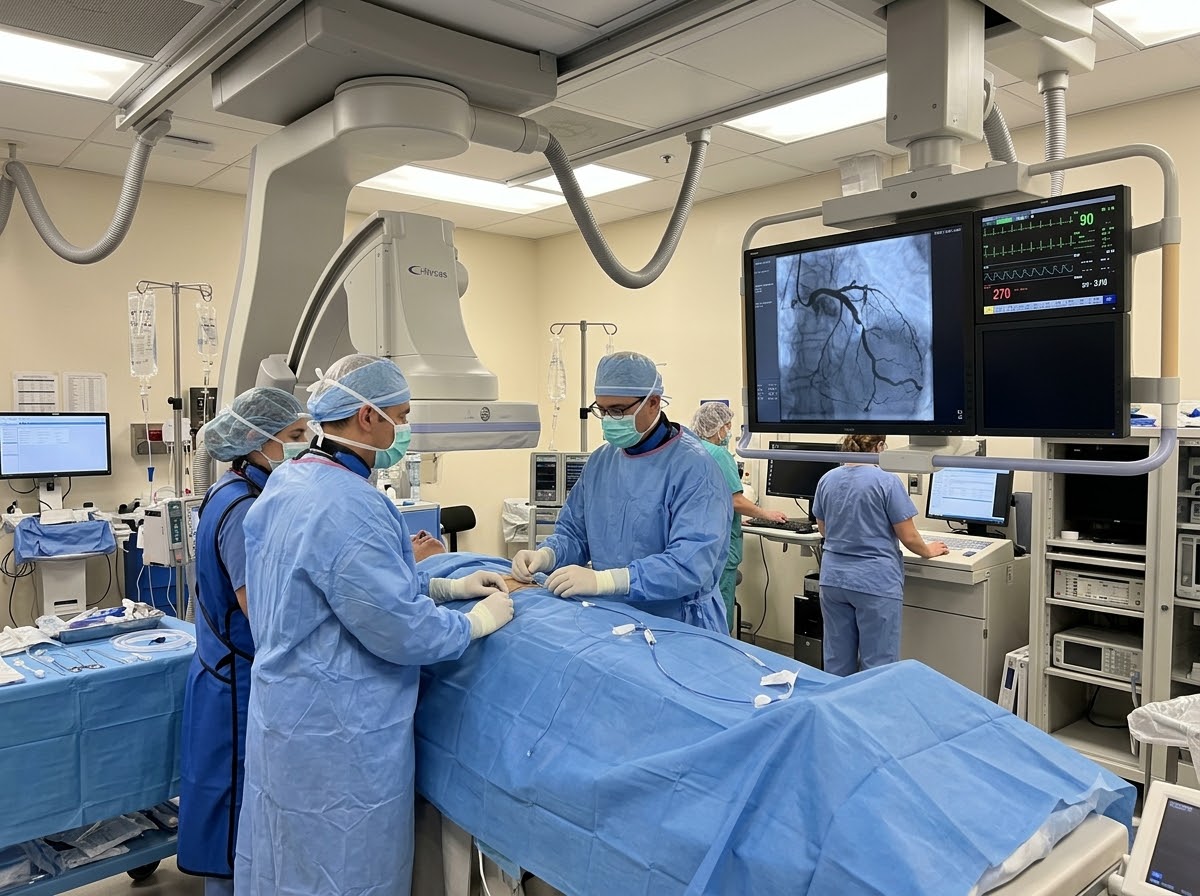
What is Coronary Artery Blockage?
Your heart is a muscle, and like every muscle it needs its own blood supply. Three main arteries sit on the surface of the heart and carry that blood. These are called the coronary arteries.
Over the years, fat, cholesterol and calcium can slowly stick to the inside wall of these arteries. Doctors call this atherosclerosis — plaque buildup in arteries. As the layer grows, the pipe becomes narrower and less blood passes through. This narrowing (written in reports as coronary artery stenosis) is what people commonly call heart blockage or nas block hona. Because the heart muscle now gets reduced blood flow, the overall condition is called coronary artery disease (CAD) or ischemic heart disease.
Think of it like the water pipe at home. When scale and dirt build up inside the pipe for years, the water flow becomes thin. At first you manage. But one day the pipe chokes completely and water stops. A coronary artery behaves exactly the same way — and when it chokes completely, that part of the heart muscle stops getting blood. That is a heart attack.
What does "70% blockage" or "90% blockage" mean?
The percentage simply tells you how much of the artery’s opening is closed. A 70% blockage means only about 30% of the passage is left for blood to flow. Below 50%, most people feel nothing and medicines are usually enough. Above 70%, symptoms usually start during walking or exertion. Above 90%, the risk of complete closure becomes high and treatment is usually urgent.
Important: the percentage alone does not decide the treatment. Where the blockage is, how many arteries are involved, and how your heart is pumping matter just as much. That is why two people with "70% blockage" can get two completely different advices — and both can be correct.
What Causes Coronary Artery Blockage?
Blockage does not form in a day. It builds up quietly over 10 to 20 years. Some reasons are in your control, and some are not.
You can control these
- High blood pressure that is not controlled
- Diabetes — a very big risk factor in India
- High cholesterol
- Tobacco in any form — cigarette, bidi, gutka, khaini
- Being overweight, especially belly fat
- Very little physical activity
- Oily, fried and heavy outside food
- Long-term mental stress and poor sleep
You cannot control these
- Increasing age
- Family history — heart problem in parents or siblings
- Being male (risk rises earlier in men)
- In women, risk increases after menopause
- Indian origin — South Asians develop heart disease around 10 years earlier than Western populations
This is why a heart check-up is advised from age 40 in India, and from 30 if a parent had an early heart attack.
What Are the Symptoms of Coronary Artery Blockage?
In the early stage, blockage often gives no symptom at all. Many people find out only during a routine check-up. Symptoms usually appear once the narrowing crosses about 70%.
Heart blockage symptoms — early warning signs to get checked
- Chest heaviness or pressure while walking, climbing stairs or working — and it settles after a few minutes of rest. This is the classic pattern of chest pain due to blockage. It feels like weight or tightness, not a sharp needle-like pain.
- Getting breathless sooner than you used to on the same amount of work
- Unusual tiredness or weakness without any clear reason
- Discomfort in the left arm, shoulder, jaw, neck or upper back during exertion
- Sweating or uneasiness during normal activity
- Repeated "gas" or "acidity" feeling that keeps coming back, especially with walking
One point every family should know: in people with diabetes, and often in women and elderly patients, there may be no chest pain at all. The only sign may be breathlessness, extreme tiredness or sudden sweating. This is called silent blockage, and it is dangerous precisely because it is quiet.
Emergency signs — do not wait, call now
If any of these happen, it may be a heart attack. Do not drive yourself, do not wait for the pain to settle, and do not take a home remedy first.
- Chest pain lasting more than 10–15 minutes
- Chest pain even while sitting or resting
- Cold sweating with restlessness or fear
- Severe breathlessness or vomiting with chest discomfort
- Fainting or sudden collapse
- Pain spreading to jaw, both arms or back with sweating
Which Test Detects Heart Blockage?
No doctor can confirm blockage just by listening to your chest. A heart blockage checkup is done step by step — simple tests first, and the detailed one only if it is really needed. Here is exactly what each test feels like, so there is nothing to fear.
ECG
Small stickers are placed on your chest and limbs to record the heart’s electrical activity. Nothing enters the body.
Read about ECG2D Echocardiography
An ultrasound of the heart. Gel is applied on the chest and a probe is moved over it to see the pumping and the valves.
Read about 2D EchoTMT (Treadmill Test)
You walk on a treadmill while the ECG runs. It shows whether the heart struggles when it has to work harder.
Read about TMTStress & Contrast Echo
An echo done while the heart is under stress. Useful when a person cannot walk on a treadmill or the TMT result is unclear.
Read about Stress EchoHolter Monitoring
A small recorder worn for 24 or 48 hours during your normal routine, to catch problems that a 5-minute ECG can miss.
Read about HolterTest for Heart Blockage: Coronary Angiography
The final confirming test. A thin tube is passed from the wrist, dye is injected, and the exact blockage is seen live on screen. Only local anaesthesia is used — you stay awake and talking.
Read about AngiographyTreatment for Blocked Heart Arteries: Does Every Blockage Need a Stent?
No — and this is the most important thing to understand on this page. A stent is not the answer for every blockage. Treatment is decided by how severe the narrowing is, where it sits, and how your heart is functioning. The honest approach is step-by-step.
Medicines and lifestyle — for mild to moderate blockage
If the narrowing is below roughly 70% and you have no serious symptoms, medicines are usually enough. Blood thinners, cholesterol-lowering tablets, BP and sugar control, plus walking, quitting tobacco and diet changes can stop the blockage from growing. Many patients stay stable on medicines for years and never need a procedure.
Angioplasty with stent — for significant blockage
When the blockage is severe, or symptoms continue despite medicines, the artery is opened from inside. A balloon widens the narrowed part and a small metal mesh tube (stent) is placed to keep it open. There is no cut on the chest. It is done through a small puncture in the wrist, under local anaesthesia, and you remain awake.
Bypass surgery (CABG) — when it is the safer choice
If all three arteries are heavily blocked, or the main left artery is involved, or the patient has diabetes with complex disease, open-heart bypass surgery may give a better long-term result than stents. In such cases we will tell you clearly and refer you for surgery. Choosing the right treatment matters more than choosing our own procedure.
How the decision is actually made: after your angiography, the cardiologist looks at the images with you, explains what he can see, and tells you the options with the reason behind each. If a stent is not needed, we say so. If surgery is the better path, we say that too. You should never leave the hospital without understanding why a treatment was chosen.
Blocked Artery Treatment: Procedures Available in Raipur
Not every blockage is simple. Some are old and fully closed, some are heavily calcified, and some come back after an earlier stent. Our Cath Lab is equipped for all of these situations.
Coronary Angiography
The diagnostic step that shows the exact location and severity of every blockage before any treatment decision.
Learn moreAngioplasty & Stenting
The blocked artery is widened with a balloon and held open with a stent. No chest cut, local anaesthesia only.
Learn morePrimary Angioplasty (Emergency)
Done during an ongoing heart attack to reopen the artery immediately. Every minute saved protects more heart muscle.
Learn moreCTO Angioplasty
For arteries that have been 100% closed for a long time. A specialised technique that many centres do not attempt.
Learn moreRota Angioplasty
For hard, calcium-loaded blockages. A tiny rotating burr shaves the calcium so the balloon and stent can pass through.
Learn moreIVUS & FFR Guided Angioplasty
Imaging and pressure measurement from inside the artery. It confirms whether a stent is truly needed and places it accurately.
Learn moreFailed Angioplasty Management
When an earlier angioplasty did not succeed or the stent has narrowed again, the case is re-assessed and re-treated.
Learn morePost-CABG Angioplasty
For patients who had bypass surgery earlier and now have a new or recurring blockage in a graft or artery.
Learn moreWhy Choose Prathmesh as Your Heart Blockage Specialist in Raipur
Blockage treatment is time-sensitive and judgement-driven. Both matter more than anything else.
Treated by DM Cardiology consultants
Your angiography and angioplasty are performed by the senior consultant himself, not delegated to junior staff.
Advanced Cath Lab with IVUS & FFR
3D angiography plus imaging from inside the artery — so a stent goes in only where it is genuinely required.
24x7 emergency angioplasty
A fully equipped CCU and an on-call cath lab team, because a heart attack does not wait for OPD hours.
Honest, need-based advice
If medicines will do the job, we will tell you. If bypass surgery is safer for you, we will say that instead.
Everything under one roof
ECG, echo, TMT, angiography, angioplasty and follow-up in one place — no running between labs and hospitals.
Metro-level care, close to home
The same technology and technique used in metro cardiac centres — without travelling to Nagpur or Delhi with a sick patient.
Who Will Treat You
Your case is handled directly by one of our senior cardiologists. You can read their full profile before your visit.
800 × 1000 px · JPG

Dr. Gaurav Tripathi
Handles complex coronary blockages, CTO and emergency angioplasty, with IVUS and FFR guided decision making.
800 × 1000 px · JPG
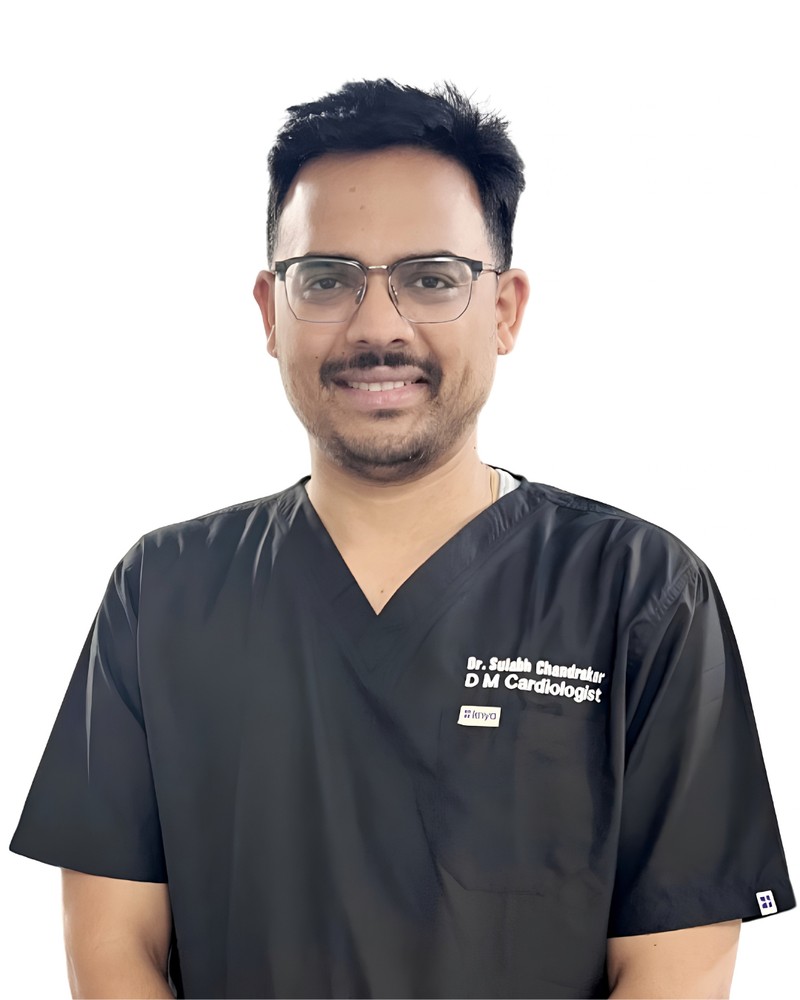
Dr. Sulabh Chandrakar
Focuses on medical management of coronary disease, rhythm problems, device implantation and preventive heart care.
Questions Patients Ask Us Most
The most typical symptom is heaviness, pressure or tightness in the chest while walking, climbing stairs or working, which settles after a few minutes of rest. Others include getting breathless sooner than before, unusual tiredness, and discomfort in the left arm, jaw, neck or back during exertion. In people with diabetes, in women and in the elderly there may be no chest pain at all — only breathlessness, tiredness or sudden sweating.
Blockage is caused by atherosclerosis — a slow buildup of fat, cholesterol and calcium (plaque) inside the artery wall over 10 to 20 years. Uncontrolled BP, diabetes, high cholesterol, tobacco, belly fat and lack of exercise speed it up. Increasing age, family history and South Asian origin add to the risk.
Diagnosis is done step by step. An ECG and a 2D Echo come first, followed by a TMT or stress echo to see how the heart behaves when it has to work harder. If these suggest a significant blockage, coronary angiography confirms its exact location and severity. No doctor can confirm a blockage just by listening to the chest.
Coronary angiography is the test that directly shows a blockage and how severe it is. Before that, a TMT (treadmill test) or stress echo shows whether the heart gets reduced blood flow during exertion, while an ECG and echo check the rhythm and pumping. A normal resting ECG on its own does not rule out a blockage.
It depends on how severe the blockage is. Mild to moderate blockage is usually treated with medicines and lifestyle changes. Significant blockage, or symptoms that continue despite medicines, is treated with angioplasty and a stent through a small puncture in the wrist. If all three arteries or the main left artery are heavily blocked, bypass surgery may be safer, and the cardiologist will explain why before anything is decided.
Yes, in many cases. Mild and moderate blockages are commonly managed with medicines and lifestyle correction, and patients stay stable for years. Even when a blockage has to be opened, angioplasty is not open surgery — there is no cut on the chest. Only some patients with complex disease are advised bypass surgery.
Every blockage needs medicines and control of BP, sugar, cholesterol and tobacco. A procedure is usually considered when the narrowing is significant (often above about 70%), when chest pain or breathlessness continues despite medicines, when tests show part of the heart is short of blood, or during a heart attack. Where the decision is borderline, FFR measurement inside the artery helps decide whether a stent is truly needed.
In most people it can be prevented or at least slowed down. Stop tobacco completely, keep BP, sugar and cholesterol in the target range your doctor gives, walk 30 to 40 minutes on most days, and prefer home-cooked food with less oil, salt and sugar. A heart check-up from age 40, or from 30 if a parent had an early heart attack, helps catch it early.
No. Angioplasty is not open surgery and there is no cut on the chest. A thin tube is passed through a small puncture in the wrist (sometimes the groin), and the blockage is opened from inside the artery. Only local anaesthesia is used, so you stay awake and can talk to the doctor throughout.
The stent stays in the artery permanently and becomes part of the vessel wall. It does not need to be removed or replaced. However, a stent treats one blocked spot — it does not cure the disease. New blockage can form elsewhere if BP, sugar, cholesterol and tobacco are not controlled, so medicines and follow-up are not optional.
Gas-related pain is usually sharp, changes with position or burping, and is linked to meals. Heart-related pain is more often a heaviness or pressure, appears during walking or exertion, and settles with rest. But the two can feel very similar, and many heart attacks are first mistaken for acidity. If you are above 40, or have diabetes or BP, get an ECG done rather than guessing.