
What Is Primary Angioplasty?
Primary angioplasty is emergency angioplasty done while a heart attack is actually happening. In a major heart attack (doctors call it a STEMI), a clot has suddenly and completely blocked one of the heart arteries. The muscle beyond that point is getting no blood at all and begins to die within minutes.
In primary angioplasty the cath lab team goes straight in through the wrist or groin, finds the blocked artery, pulls out or pushes aside the clot, opens the vessel with a balloon and places a stent — restoring blood flow to that muscle as fast as humanly possible.
"Primary" simply means it is the first and main treatment, done instead of a clot-dissolving injection. When a 24x7 cath lab is available, this is the best treatment for a major heart attack, because it opens the artery more reliably and more completely than any injection can.
There is one number that matters more than anything else here: time. From the moment the artery blocks, heart muscle starts dying. Open it within the first hour or two and most of the muscle is saved. Open it after many hours and much of the damage is already permanent. This is what cardiologists mean when they say "time is muscle".
Why not just take the clot-dissolving injection? A thrombolytic injection dissolves the clot in roughly half to two-thirds of patients, and it carries a small risk of bleeding into the brain. Primary angioplasty opens the artery in the large majority of patients, confirms with your own eyes on the screen that flow is restored, and treats the underlying narrowing at the same time. Where a cath lab is reachable in time, angioplasty is the better option. Where it is far away, the injection is given first and angioplasty follows within the next day — this combination is called the pharmaco-invasive approach.
Why Is Primary Angioplasty Done? — Indications
Primary angioplasty has one purpose: to restore blood flow to dying heart muscle before the damage becomes permanent. It is done to:
- Save heart muscle — Every 30 minutes of delay costs muscle. The amount of muscle saved decides your pumping strength (EF) for the rest of your life.
- Improve survival — Early reopening of the artery reduces deaths from a major heart attack. This is one of the clearest, most proven benefits in all of cardiology.
- Prevent heart failure later — A large heart attack leaves a weak, scarred heart. Opening the artery early is the single best way to avoid lifelong breathlessness and swelling from heart failure.
- Reduce dangerous rhythm problems — Muscle that is starved of blood is electrically unstable and can trigger a cardiac arrest. Restoring flow settles this.
- Treat the cause, not just the clot — The clot forms on a diseased, narrowed segment. Angioplasty removes the clot and treats the narrowing underneath with a stent in the same sitting.
Who May Need Primary Angioplasty?
Primary angioplasty is for anyone having a major heart attack now, where the ECG shows a complete blockage pattern (STEMI). Specifically:
- Chest pain with a STEMI pattern on ECG — The ECG is done within minutes of arrival; this one test decides that you go straight to the cath lab.
- Pain that started within the last 12 hours — The benefit is greatest in the first few hours, but it remains worthwhile up to about 12 hours, and longer if pain and ECG changes are continuing.
- A heart attack with low BP, shock or severe breathlessness — These patients are the sickest and often benefit the most — angioplasty is preferred over an injection here.
- When a clot-dissolving injection has failed — If an injection was given elsewhere and the pain and ECG changes persist, you are brought for rescue angioplasty.
- Patients who cannot be given a clot-dissolving injection — Recent surgery, a bleeding problem, a previous brain haemorrhage or very high blood pressure make the injection unsafe. Angioplasty becomes the only option.
A note on when it is not needed: If several days have passed since the heart attack, the pain has fully settled and the ECG has stabilised, emergency primary angioplasty is no longer the right treatment — the muscle in that territory is already lost. In that situation you are stabilised with medicines and assessed with angiography in a planned way, and the decision about a stent is taken on its own merit. Rushing a stent into a dead territory does not help, and a good cardiologist will tell you this rather than doing a procedure for the sake of it.
Types / Variations of Primary Angioplasty
Primary angioplasty (primary PCI)
The standard treatment: straight to the cath lab, artery opened with balloon and stent. Done around the clock, including nights and holidays.
Thrombus aspiration
When a very large clot is present, it can be sucked out through a catheter before the stent is placed, so that less of it is pushed downstream.
Rescue angioplasty
Done when a clot-dissolving injection has been given — usually at a smaller hospital — and the artery has not opened, which shows up as continuing pain and unchanged ECG.
Pharmaco-invasive approach
The injection is given first where the cath lab is far, the patient is transferred, and angiography with angioplasty is done within about 3–24 hours. This is a planned strategy, not a failure.
Culprit-only vs complete revascularisation
During the emergency, the artery that caused the attack is opened first. Other blockages, if present, are usually treated in a planned second sitting days to weeks later.
Angioplasty with mechanical support
In patients in cardiogenic shock, a pump device or balloon support may be used alongside the angioplasty to support the circulation.
Your cardiologist will tell you which type or technique is right for you after reviewing your reports.
Benefits of Primary Angioplasty
- It is the most effective treatment for a major heart attack — It opens the blocked artery more reliably and more completely than a clot-dissolving injection, and the result can be seen immediately on screen.
- It saves heart muscle, which decides your future — Less muscle lost means a stronger pump, fewer symptoms, less heart failure and a better life afterwards.
- It improves survival — The reduction in death after a major heart attack with early angioplasty is one of the best-established facts in modern cardiology.
- No risk of bleeding into the brain from a clot-buster — A small but devastating risk of thrombolytic injections is avoided entirely.
- The underlying blockage is treated at the same time — The stent treats the diseased segment that caused the clot, not just the clot itself.
- Available 24x7 at Prathmesh — Our cath lab team and CCU are on call round the clock, because heart attacks do not keep office hours.
How Primary Angioplasty Is Performed
There is no time for the usual admission routine. Everything happens in parallel: the ECG, the blood thinners, the consent, the paperwork and the cath lab preparation all run together. Here is what will happen from the moment you reach us.
ECG within minutes of arrival
An ECG is taken immediately at the entrance or in casualty. If it shows a STEMI, the cath lab team is activated by phone right away — before admission formalities are complete.
Emergency medicines are given at once
Aspirin and a second blood thinner are given to chew or swallow, along with other medicines. These start working on the clot while you are being shifted.
You are shifted straight to the cath lab
Monitoring, oxygen if needed and an IV line go in on the way. A family member signs consent while preparation continues — we explain what is being done as fast as it is safe to do so.
Local anaesthetic and access
The wrist (or groin) is numbed and a sheath is placed. This takes a minute; everything else passes through it.
The blocked artery is found
Dye is injected and the culprit artery is identified — on the screen it simply stops where the clot is. You may be shown this.
The artery is opened
A wire is passed through the clot and a balloon is inflated. Blood flow returns, often immediately, and many patients feel the chest pain ease within seconds to minutes.
The clot is removed and a stent is placed
If the clot load is heavy it may be aspirated. A stent is then placed across the diseased segment to keep the artery open, and the final result is checked with dye.
Transfer to the CCU
You are shifted to the coronary care unit for continuous monitoring. The first 24–48 hours are the period when rhythm problems are most likely, and this is why the CCU stay matters.
What the family should do while this is happening The single most useful thing is to let the team move fast. Papers, payment formalities and insurance can be sorted in parallel — our staff will guide you, and at no point should paperwork delay the opening of the artery. Bring any old reports and the medicine list if they are at hand, but do not go home to fetch them.
Preparation Before Primary Angioplasty
This is an emergency, so there is almost no preparation in the usual sense. What matters is what happens before you reach hospital — and that is where families can genuinely change the outcome.
Please do
- Call for help immediately if someone has chest pain lasting more than 10–15 minutes, especially with sweating, breathlessness or vomiting.
- Make the person sit or lie down and keep calm. Do not let them walk or climb stairs.
- If aspirin is available at home and the person is not allergic to it, give one tablet to chew — this is standard first aid for a suspected heart attack.
- Come straight to a hospital with a 24x7 cath lab if you can reach one quickly.
- Carry the medicine list and old reports if they are immediately at hand.
- Tell the casualty staff right away that the pain is in the chest — do not wait quietly in the queue.
Please avoid
- Do not drive yourself to hospital. Take an ambulance or let someone else drive.
- Do not wait to see if the pain settles, and do not take antacids and go back to sleep — this is how hours are lost.
- Do not give food or water once a procedure is likely.
- Do not insist on going to a hospital without a cath lab because it is familiar — the clock is what matters, and so is where the artery can actually be opened.
- Do not delay for paperwork, money arrangements or waiting for a relative to arrive.
The first hour decides a lot. If the artery is opened within the first 60–120 minutes of the pain starting, a large part of the heart muscle can be saved. After about 6 hours much of the damage is already done, and after 12 hours most of it is permanent. Everything in heart attack care is a race against this clock — which is exactly why you should not wait at home.
Tests Required Before Primary Angioplasty
- ECG — done within minutes — The one test that decides everything. A STEMI pattern sends you straight to the cath lab without waiting for any other result.
- Troponin and other cardiac blood tests — Taken alongside, but treatment is never delayed to wait for the report in a clear-cut STEMI.
- Basic blood tests — haemoglobin, creatinine, sugar, clotting — Drawn while preparation continues, so kidney function and bleeding risk are known as early as possible.
- Bedside echo — Sometimes done quickly in the cath lab or CCU to assess the pumping and rule out other causes of chest pain.
- Chest X-ray — Done when the picture is unclear or there is severe breathlessness — but never at the cost of delaying the cath lab.
In a clear heart attack, the ECG alone is enough to take you to the cath lab. Every other test runs in parallel. If anyone tells you to wait for a troponin report before treatment in an obvious STEMI, that is a delay worth questioning.
Anaesthesia / Sedation Used in Primary Angioplasty
Local anaesthesia at the wrist or groin, exactly as in a planned angioplasty. You stay awake, which also allows the team to keep talking to you and assessing you.
Strong pain relief is given through the IV line, usually morphine or a similar drug, because a heart attack is genuinely painful and controlling the pain also reduces strain on the heart.
Medicines for nausea, oxygen if the levels are low, and drugs to support blood pressure are given as needed.
A small number of patients who are very unstable — in shock, unconscious, or struggling to breathe — may need a breathing tube and ventilator support. That is a consequence of the heart attack itself, not of the angioplasty.
How Long Does Primary Angioplasty Take?
The angioplasty itself usually takes about 45–90 minutes. But the number the team is really watching is different: the time from your arrival at the hospital to the moment the artery is opened, known as door-to-balloon time. The target is under 90 minutes, and shorter is better.
An even more important clock starts earlier — when your chest pain began. Most of the delay in India happens before reaching hospital, not inside it. A patient who waits five hours at home has lost more muscle than any hospital team can recover.
Hospital Stay / Admission for Primary Angioplasty
The usual stay after primary angioplasty is about 3–5 days. The first 24–48 hours are spent in the CCU with continuous ECG monitoring, because dangerous rhythm problems, if they happen, usually happen in that window.
After that you move to a ward bed, start walking under supervision, and the medicines are adjusted. An echo is done before discharge to measure the pumping (EF) — this number guides the medicines you will be on afterwards.
A larger heart attack, a heart attack complicated by heart failure or shock, or one where the pumping is very weak, needs a longer stay. Before discharge you should receive the stent card, a clear medicine list with durations, lifestyle instructions and a follow-up date, and ideally a cardiac rehabilitation plan.
Risks & Possible Complications of Primary Angioplasty
Primary angioplasty carries somewhat higher risk than a planned angioplasty — not because the procedure is different, but because the patient is critically ill at that moment. It is essential to compare these risks against the alternative, which is an untreated heart attack: that carries a far higher risk of death and of permanent heart damage.
Common and minor
- Chest heaviness during balloon inflation, which settles immediately.
- Bruising, pain or a lump at the puncture site.
- Low blood pressure or nausea during the procedure, managed with medicines.
- Rhythm disturbances at the moment the artery opens, which are usually brief and are treated on the table.
Uncommon or rare
- Bleeding needing transfusion, more likely because strong blood thinners have been given.
- No-reflow — the big artery opens but the tiny vessels beyond stay blocked, limiting the benefit.
- Kidney function dropping after the dye, especially in shock or pre-existing kidney disease.
- Stent thrombosis — a clot inside the new stent, which is why blood thinners must never be missed.
- Cardiac arrest, stroke, or the need for emergency surgery or mechanical support — these risks reflect the severity of the heart attack itself.
- Death — the risk is real in a major heart attack with shock, and much lower in a patient who reaches hospital early and is otherwise stable. Your own risk should be explained to your family directly.
The risk of not doing it is higher. This is the one procedure where refusing or delaying is clearly more dangerous than proceeding. An untreated major heart attack carries a substantial risk of death and leaves permanent muscle damage in those who survive. If a family hesitates over cost or paperwork, speak to the team — those things can be sorted afterwards; the artery cannot be reopened later.
Recovery After Primary Angioplasty
Continuous monitoring, bed rest initially, IV medicines and frequent checks. Chest pain usually settles once the artery is open. Tell the nurse immediately if any pain returns.
You start sitting up, then walking short distances with supervision. Medicines are adjusted and an echo is done to measure the pumping.
You go home with the stent card, a precise medicine list and clear instructions. Go through each tablet with the doctor before leaving so there is no confusion at home.
Light activity at home, short walks on level ground, no heavy lifting and no driving. Chest pain, breathlessness or swelling of the feet means you call us, not wait.
Walking is increased gradually. Cardiac rehabilitation, where available, is strongly recommended after a heart attack — it improves both capacity and confidence. Desk work usually restarts around 2–4 weeks; heavy physical work later, as advised.
Usually resumed around 2–4 weeks after an uncomplicated heart attack, but this must be individualised — ask your doctor for your case.
Medicines, risk-factor control and follow-up echoes. Pumping that was reduced at discharge can improve over the following months, and the medicines are adjusted according to that.
Aftercare & Precautions After Primary Angioplasty
- Take the blood thinners every single day without a gap — after a stent placed during a heart attack, this is the most important instruction you will receive.
- Take the statin, beta-blocker and other heart medicines exactly as prescribed, even when you feel completely well.
- Carry the stent card always and show it to every doctor and dentist who treats you.
- Stop tobacco completely — continuing to smoke after a heart attack sharply increases the risk of another one.
- Join cardiac rehabilitation if it is offered, and walk daily as advised.
- Weigh yourself regularly if you have been told your pumping is weak, and report sudden weight gain or increasing swelling of the feet.
- Keep BP, sugar and cholesterol at the targets your cardiologist sets, and attend every follow-up.
- Keep a copy of the discharge summary, the angiography CD and the stent card together in one file.
- Treat any new chest pain as an emergency — do not take an antacid and wait.
Success / Expected Outcomes of Primary Angioplasty
In a patient who reaches hospital early and whose artery is opened quickly, primary angioplasty usually restores flow successfully and limits the damage substantially. Many such patients leave hospital with a near-normal pumping function and go on to live a full, active life.
If several hours have passed before treatment, some muscle is already lost and the pumping (EF) may be permanently reduced. Even then, opening the artery helps — it stabilises the heart and reduces later complications — but it cannot bring back muscle that has already died.
The second part of the outcome is in your hands. After a heart attack, the risk of another one is real but very substantially reduced by medicines, stopping tobacco, controlling BP, sugar and cholesterol, and regular exercise. The patients who do badly in the years afterwards are usually those who stopped their medicines once they felt well.
The number to ask about at discharge Ask what your EF (pumping percentage) is at discharge and what it should be rechecked at. If it is reduced, the right medicines started early can genuinely improve it over the next 3–6 months — but only if they are taken consistently.
When to Seek Medical Help After Primary Angioplasty
After a heart attack, some symptoms must never be watched and waited on. Call us or reach the nearest emergency department immediately if you notice:
- Chest pain, heaviness or pressure returning — treat it as a new heart attack until proven otherwise
- Severe breathlessness, or breathlessness on lying flat that wakes you at night
- Swelling of the feet or sudden weight gain over a few days
- Fainting, severe dizziness, or a very fast or irregular heartbeat
- You have missed or run out of your blood thinners, or a doctor has asked you to stop them
- Black stools, blood in vomit or urine, or unusual bruising
- Fever, or redness, warmth or discharge at the puncture site
- Bleeding from the puncture site: press firmly with the other hand and call us
Primary Angioplasty — Questions Patients Ask
As fast as possible. The greatest benefit is in the first one to two hours after the pain begins, and the target inside the hospital is to open the artery within 90 minutes of your arrival. The benefit remains clear up to about 12 hours, and in some patients with continuing pain even beyond that. In practice, most of the delay in India happens at home, not in the hospital — people wait to see if the pain settles. That waiting costs heart muscle that can never be recovered.
Where a 24x7 cath lab can be reached in time, primary angioplasty is better: it opens the artery in a much higher proportion of patients, you can see on the screen that flow has returned, the underlying narrowing is treated at the same time, and there is no risk of bleeding into the brain. Where a cath lab is several hours away, the injection should be given first without delay and angioplasty done within the next 3–24 hours. The wrong choice is to do neither while travelling from hospital to hospital.
Treatment is not held back for paperwork — the ECG, the emergency medicines and the cath lab activation happen first. The cost depends on the number of stents, the devices used and the length of CCU stay. Government health schemes and most insurance policies cover emergency angioplasty, and our staff start the pre-authorisation while the procedure is under way. Ask for the written estimate as soon as the patient is stable; your family will not be left guessing.
Emergency primary angioplasty is no longer the right treatment once several days have passed and the pain has settled — that muscle is already affected, and rushing in gains nothing. But angiography is still very important, to see the state of all three arteries and decide whether a stent or bypass is needed to protect the remaining muscle. This is done in a planned way, after you are stabilised on medicines. Bring all records from the first hospital.
It depends almost entirely on how quickly the artery was opened. Muscle that was starved but not dead recovers over weeks to a few months, and your EF at discharge is often not the final number — a repeat echo at follow-up may be better. Muscle that died becomes scar and does not return. This is why the first few hours matter so much, and why the medicines started at discharge are not optional.
Feeling fine after the artery is opened is a good sign, but the first 24–48 hours after a heart attack are when dangerous rhythm problems are most likely, and they can appear without warning in someone who feels well. In the CCU your rhythm is watched continuously and such a problem can be treated within seconds. It is a short period of monitoring that exists precisely for the patient who feels fine.
The risk is real, but it is reduced very substantially by doing a small number of things consistently: taking the blood thinners and the statin exactly as prescribed, stopping tobacco completely, keeping BP and blood sugar at target, walking regularly, keeping weight in check, and coming for follow-up. Most patients who have a second event are those who stopped their medicines or kept smoking. This part of the result is genuinely in your control.
Most people with office jobs return to work about 2–4 weeks after an uncomplicated heart attack with a successful angioplasty. Heavy physical work, driving for a living, and long-distance travel need individual clearance from your cardiologist, often after an assessment of your pumping and exercise capacity. Cardiac rehabilitation helps you get back faster and with more confidence — ask about it before discharge.
Yes, and in cardiogenic shock angioplasty is usually the treatment that offers the best chance, often alongside breathing support, blood-pressure medicines or a mechanical support device. The risks in that situation are high and will be explained to you honestly — but the alternative, which is an unopened artery in a failing heart, is worse. Decisions here are taken quickly, and the team will keep the family informed at each step.
Yes — unless the person is allergic to aspirin or has been told not to take it. One tablet chewed (not swallowed whole) is standard first aid for a suspected heart attack and starts working on the clot immediately. After that, move. Do not let the aspirin become a reason to wait and watch at home, and do not drive the patient yourself if an ambulance or another driver is available.
Yes. A heart attack does not wait for OPD hours, so our cath lab team and CCU are on call 24x7, including nights, Sundays and holidays. If you suspect a heart attack, call +91 77778 65621 on the way — telling us in advance lets the team be ready before you arrive, which saves minutes that matter.
Usually only the artery that caused the heart attack — the culprit artery — is stented during the emergency. If other arteries also have significant blockages, they are normally treated in a planned second sitting days to weeks later, which is safer than doing everything while the heart is still recovering. If more is done in the same sitting, there should be a specific reason and your family should be told.
Why Choose Prathmesh Cardiac Institute for Primary Angioplasty?
Experienced hands, the right equipment and honest advice — the three things that matter most for a safe procedure.
Experienced DM cardiologists
Dr. Gaurav Tripathi and Dr. Sulabh Chandrakar — experienced interventional cardiologists who perform Primary Angioplasty regularly.
Advanced, modern Cath Lab
3D angiography with IVUS and FFR guidance — the latest equipment for safe, precise procedures.
24x7 emergency & critical care
A fully equipped CCU and an on-call cath lab team, because heart emergencies do not wait for OPD hours.
Transparent pricing & insurance help
Costs are explained clearly before the procedure, and our team helps you check what your insurance or government health scheme covers.
Complete heart care under one roof
ECG, echo, TMT, angiography, procedures and follow-up in one place — from diagnosis to treatment.
Metro-level care, close to home
The same technology and technique used in metro cardiac centres — without travelling far with a sick patient.
Specialists & Facilities Available
Your procedure is planned and performed by our senior DM Cardiology consultants. You can read their full profiles before your visit.
800 × 1000 px · JPG
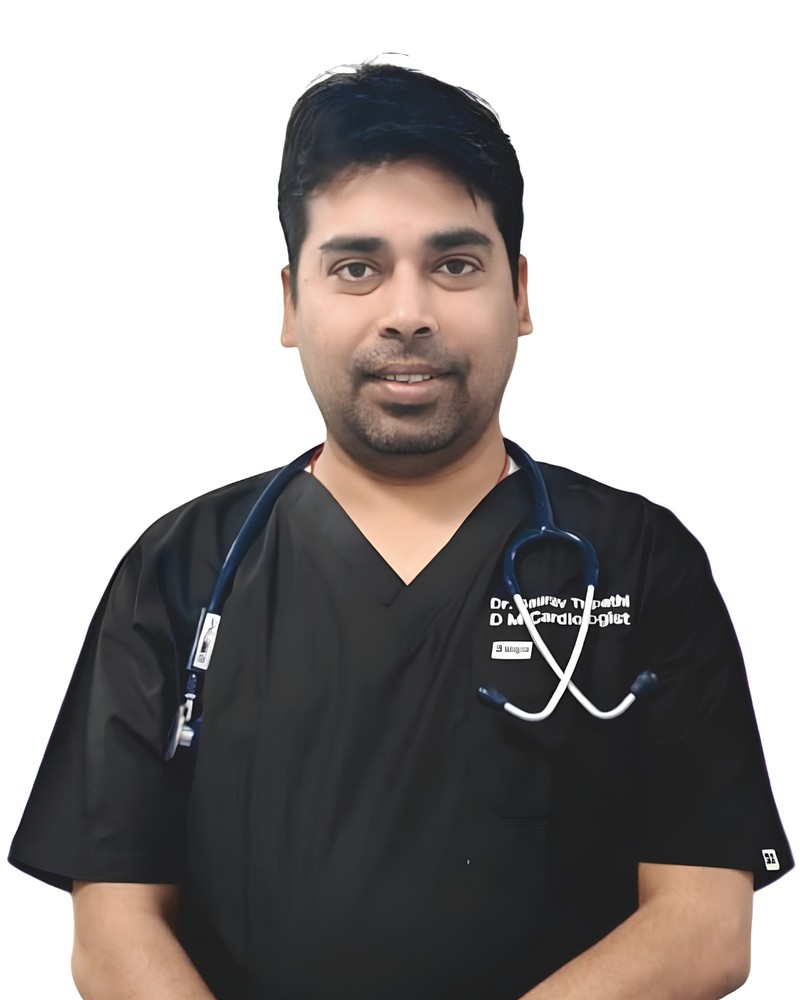
Dr. Gaurav Tripathi
Handles complex coronary blockages, CTO, rotablation and emergency angioplasty, with IVUS and FFR guided decision making.
800 × 1000 px · JPG
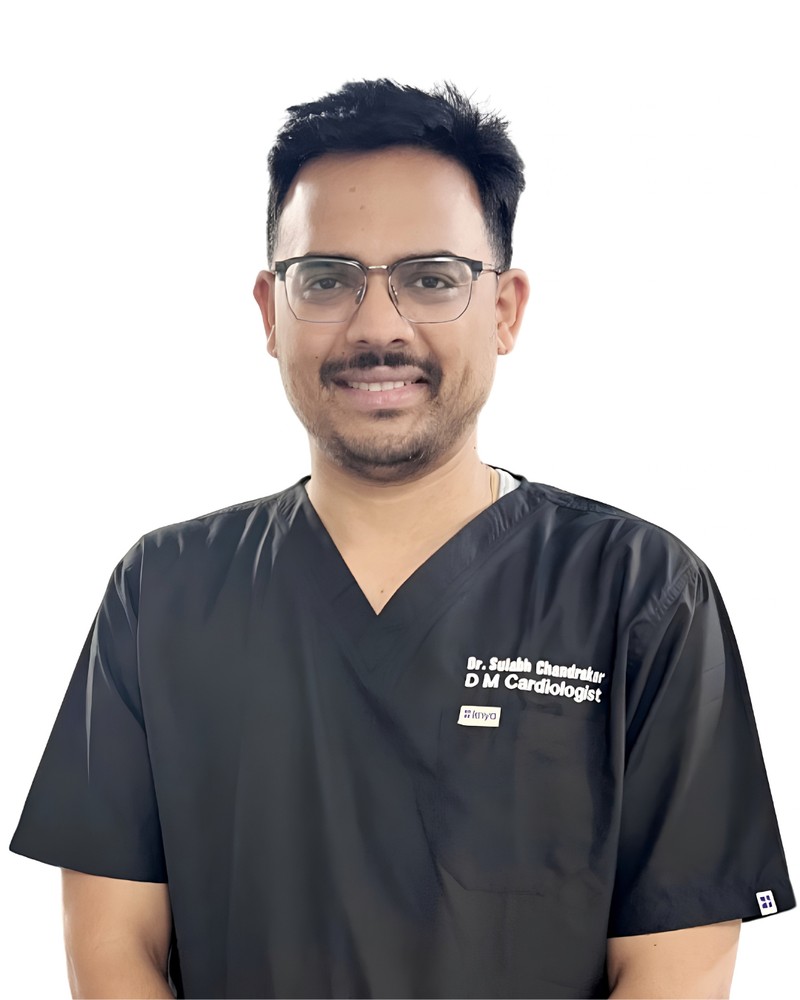
Dr. Sulabh Chandrakar
Performs angioplasty and manages coronary disease with a strong focus on medicines, prevention and long-term follow-up.
Facilities at Prathmesh Cardiac Institute
Book a Consultation / Procedure Appointment for Primary Angioplasty
Call or WhatsApp us, or request a call back — our team will confirm a time and tell you what to bring. Bring your previous ECG, echo, angiography reports and current medicine list.