
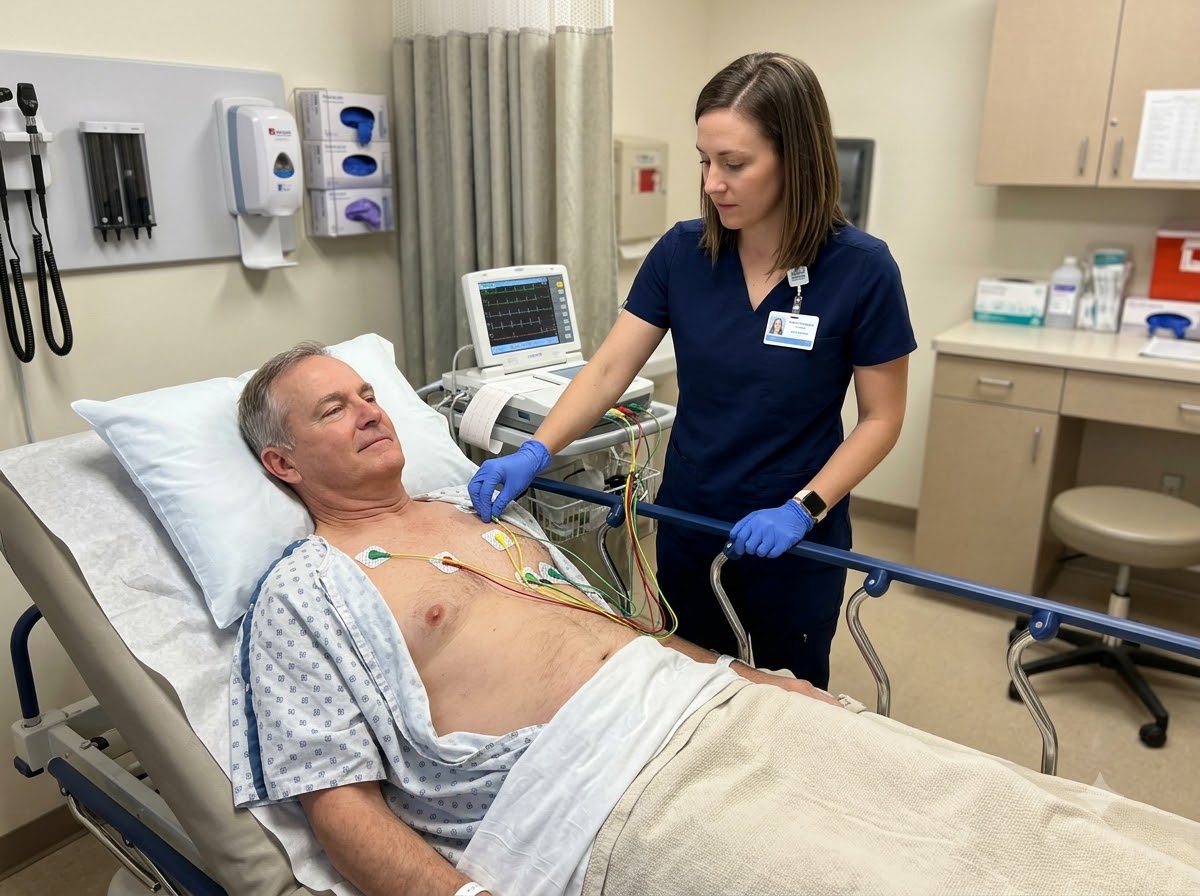
What is an ECG Test?
Every heartbeat starts with a tiny electrical signal. An ECG test — short for electrocardiogram, also called EKG — picks up that signal through small stickers placed on your chest, arms and legs, and prints it as a wavy line on paper or a screen. A cardiologist reads the shape and timing of those waves to understand how your heart is beating.
At Prathmesh Cardiac Institute we do a 12 lead ECG, which looks at the heart’s electrical activity from 12 different angles. That is why it can point to a problem in a specific part of the heart, not just say “something is wrong”.
Think of it like this: if the heart is a house, the ECG checks the electrical wiring — whether the current is flowing on time and in the right path. A 2D Echo, on the other hand, looks at the walls, doors and rooms of the house.
Why do doctors recommend an ECG first?
Because it is quick, safe, low-cost and gives useful information within minutes. In a patient with chest pain, an ECG can show signs of a heart attack in progress, which changes the treatment plan immediately. For a routine heart checkup, it gives a baseline record that future ECGs can be compared with.
When Should I Get an ECG Test?
You do not need to wait for a serious problem. Doctors ask for an ECG whenever there is a symptom that could come from the heart, and also as a routine check in people with risk factors.
Symptoms where an ECG test is useful
Routine heart checkup
- Age above 40 years, even with no symptoms
- Diabetes, high BP or high cholesterol
- Smoking or strong family history of heart disease
- Before starting a heavy exercise or gym routine
Other common reasons
- ECG test before surgery (pre-operative fitness)
- Follow-up after angioplasty, bypass or a heart attack
- Checking the effect of some heart or BP medicines
- Job, insurance or travel medical
Is ECG needed for chest pain? Yes — any new chest pain, especially with sweating, breathlessness or pain spreading to the arm or jaw, needs an ECG immediately. Do not wait for an appointment. Call +91 77778 65621 or come to our 24x7 emergency.
What Does an ECG Test Detect?
Can ECG detect heart problems? Yes, many of them. A normal-looking ECG and a changed ECG both give the doctor important clues.
Heart attack — current or old
Typical changes show when a part of the heart muscle is not getting blood, or was damaged earlier.
Heart attack treatmentIrregular heartbeat (arrhythmia)
Atrial fibrillation, extra beats and very fast or very slow rhythms are seen clearly if present at the time of the test.
Arrhythmia careHeart block
Delay in the electrical signal passing from the upper to the lower chambers, which may later need a pacemaker.
Thick heart muscle
Long-standing high BP can thicken the heart wall (LVH), which often shows up on the ECG.
Reduced blood supply (ischemia)
Changes that suggest narrowed heart arteries — the doctor may then ask for a TMT, Stress Echo or angiography.
Heart blockageSalt and medicine effects
Very high or low potassium, and the effect of certain medicines, can change the ECG pattern.
What an ECG cannot tell: a normal resting ECG does not fully rule out blockage in the heart arteries, and it cannot show the heart valves or pumping strength. That is why your doctor may add a 2D Echo, a TMT or Holter monitoring.
How is an ECG Test Done?
How long does an ECG take? The recording itself takes less than a minute. With getting ready, the whole ECG test usually finishes in 5 to 10 minutes.
You lie down comfortably
You lie on your back on a couch. You may be asked to open the shirt buttons or change into a gown. Women patients can ask for a female staff member to be present.
10 stickers (electrodes) are placed
6 on the chest and 1 on each arm and leg. If there is hair on the chest, a small area may be cleaned so the sticker holds well.
You stay still for a few seconds
Breathe normally and do not talk or move. The machine records the 12-lead ECG in about 10 seconds.
Stickers removed, report ready
The stickers are peeled off — nothing stays on the body. The ECG print is ready immediately and the cardiologist explains it to you.
No electricity goes into your body. The ECG machine only listens to the heart’s own signals, like a microphone. It is completely safe for pregnant women, children and elderly patients.
Preparation for an ECG Test — and is it Safe?
There is almost nothing to do before an ECG. A few small things simply help the stickers hold well and keep the reading clear.
Good to do
- Wear a shirt or top that opens from the front
- Bring your old ECG reports and medicine list
- Take your regular medicines unless the doctor says otherwise
- Rest for 5 minutes before the test if you walked fast or climbed stairs
Better to avoid on the test day
- Body oil, lotion or powder on the chest
- Smoking or strong tea / coffee just before the test
- Heavy jewellery or metal chains on the chest
- Talking or moving during the recording
Is an ECG test painful or risky?
No. There are no needles, no injection and no current. Some people feel a slight pull when the stickers are removed, similar to removing a bandage. There is no radiation, so the ECG can be repeated as often as the doctor needs.
What Happens After Your ECG Report?
Our cardiologist looks at your ECG together with your symptoms, BP, sugar and past history — never the ECG alone. Depending on what is seen, one of three things usually happens:
- Normal ECG, no worrying symptoms: you get advice on BP, sugar, cholesterol and lifestyle, and a date for the next checkup.
- Minor change or unclear picture: the doctor may ask for a 2D Echo, TMT or 24-hour Holter to get a complete answer.
- Signs of a heart attack or dangerous rhythm: treatment starts at once in our cardiac emergency and cath lab.
Tip: keep every ECG report in one file. A doctor comparing today’s ECG with an old one can often spot a change that a single ECG would not show.
Why Get Your ECG Test at Prathmesh Cardiac Institute?
An ECG is a simple test, but reading it correctly needs experience. Here, the same team that treats heart attacks reads your ECG.
Read by a DM cardiologist
Your ECG is interpreted by a heart specialist, not only by the machine’s automatic printout.
Explained on the same visit
You are told what the ECG shows in simple words, and what to do next.
Quick, with no long wait
The test takes minutes, so it fits into a normal OPD visit.
Next test under one roof
2D Echo, TMT, Holter and ABPM are all available here if your doctor needs more information.
24x7 emergency backup
If the ECG shows a heart attack, our cath lab and CCU are in the same building.
Easy to reach in Raipur
NH-30, Amlidih Road, Deopuri — convenient for patients from Raipur and nearby districts.
Who Reads Your Report
Your report is studied by a DM Cardiology specialist, who explains it to you in plain words and tells you what to do next.
800 × 1000 px · JPG

Dr. Gaurav Tripathi
Leads emergency heart attack care and angioplasty, and reviews ECGs of patients coming in with chest pain.
800 × 1000 px · JPG

Dr. Sulabh Chandrakar
Sees patients with palpitations, BP and long-term heart problems, and explains ECG findings in detail.
ECG Test — Questions Patients Ask Us
An ECG (electrocardiogram) is a simple, painless test that records the electrical signals of your heart using stickers on the chest, arms and legs. It shows how fast and how regularly your heart is beating and whether any part of the heart muscle is under strain.
Get an ECG if you have chest pain, palpitations, breathlessness, dizziness or fainting, and as a routine heart checkup if you are above 40 or have diabetes, high BP, high cholesterol, a smoking habit or a family history of heart disease.
Yes. Any new or severe chest pain should have an ECG as soon as possible, because it is the fastest way to see whether a heart attack is happening. If the pain is severe or comes with sweating or breathlessness, go to an emergency immediately.
An ECG can detect a current or old heart attack, irregular heartbeat such as atrial fibrillation, heart block, thickening of the heart muscle, reduced blood supply to the heart and the effect of some medicines or salts like potassium.
You lie down, 10 stickers are placed on your chest, arms and legs, and the machine records your heart signals for about 10 seconds while you stay still. The stickers are then removed. Nothing enters the body.
The recording takes less than a minute. Including getting ready, the whole ECG test usually takes 5 to 10 minutes, and the report is available immediately.
Doctors recommend an ECG because it is quick, safe and gives instant information about the heart’s rhythm and blood supply. It helps decide whether you need urgent treatment or more tests like a 2D Echo or TMT.
Yes, many heart problems show up on an ECG. But a normal ECG does not rule out every problem — for example, a blockage may only show during exercise. Your cardiologist will tell you if a TMT, Stress Echo or other test is needed.
No. You can eat and drink normally and take your regular medicines before an ECG test unless your doctor has asked for a different test on the same day.