
What is an Irregular Heartbeat (Arrhythmia)?
Your heart has its own natural electrical system. A small group of cells at the top of the heart, called the sinus node, sends out an electrical signal. That signal travels down through the heart in a fixed path and makes the chambers squeeze in the correct order. This is what produces a steady, even heartbeat.
An arrhythmia (dil ki dhadkan ka uneven hona) — also called an abnormal heart rhythm or heart rhythm disorder — means something has gone wrong with that electrical signal. It may fire too fast, too slow, from the wrong place, or take a short-circuit path. The heart muscle itself may be perfectly healthy — the problem is in the wiring, not the pump.
Think of the electrical wiring in your house. The fan is fine and the motor is fine, but if the switch is loose or a wire has a short circuit, the fan runs too fast, too slow, or flickers. That is exactly what happens in an arrhythmia. This is also why a person with a perfectly normal echo can still have a serious rhythm problem — the pump is fine, the wiring is not.
The three types you should know
Too fast (tachycardia) — the heart races above 100 beats a minute at rest. The most common serious type is atrial fibrillation (AFib), where the upper chambers quiver instead of beating properly. AFib matters because blood can pool and form a clot, and that clot can travel to the brain and cause a stroke.
Too slow (bradycardia) — the heart drops below about 50 beats a minute and cannot supply enough blood. This causes tiredness, dizziness and blackouts. A pacemaker is the definitive treatment.
Extra or skipped beats — the commonest of all, and usually harmless. That "thud" or momentary pause you feel is often just an extra beat. Most people with this need reassurance and a simple test, not treatment.
What Causes Irregular Heartbeat?
Rhythm problems have very different causes from blockage. Some are triggers you can remove today, some are structural.
You can control these
- Too much tea, coffee or energy drinks — a very common and completely reversible trigger
- Tobacco and alcohol — alcohol especially can trigger atrial fibrillation, sometimes the very next day after heavy drinking
- Thyroid problems, especially an overactive thyroid — a simple blood test finds this, and treating it often fixes the rhythm
- Low potassium, sodium or magnesium, often after vomiting, loose motions or diuretic medicines
- Anaemia and low haemoglobin, which make the heart beat faster to compensate
- Anxiety, panic and severe lack of sleep
- Some cold, asthma and weight-loss medicines that stimulate the heart
- Untreated blood pressure and untreated diabetes over the years
You cannot control these
- Increasing age — the heart’s wiring naturally degenerates over decades
- Damage after a previous heart attack, which leaves scar tissue that disrupts signals
- A heart valve problem, especially rheumatic mitral valve disease, which commonly causes AFib in India
- A weak or enlarged heart (cardiomyopathy)
- An extra electrical pathway present since birth
- Family history of rhythm problems or sudden cardiac death
Because so many triggers are reversible, a proper first assessment usually includes thyroid, haemoglobin and electrolyte blood tests. Treating those alone settles the rhythm in many patients.
Heart Palpitations and Other Symptoms of Arrhythmia
Rhythm problems are unpredictable. They can come and go in minutes, which is why they are often missed on a normal ECG. What you felt yesterday may not show up on today’s test — and that is normal, not a sign that nothing is wrong.
Common signs — heart beating fast, irregularly or too slowly
- Palpitations — feeling your own heartbeat as fluttering, racing, pounding or a skipped beat. Many describe it as a fish flapping in the chest.
- Sudden heart racing — episodes of very fast heartbeat that start and stop on their own
- Unusual tiredness and getting breathless on light activity
- Dizziness or light-headedness, especially on standing up
- Chest discomfort during an episode
- A slow heartbeat (very slow pulse), with heaviness in the head or a feeling of slowing down
- Feeling anxious or uneasy without a reason, during an episode
The one symptom that must never be ignored: fainting or near-fainting (blackouts). A blackout from a rhythm problem means the brain briefly did not get enough blood. It needs proper testing, not reassurance. If it happens while driving or on stairs, the injury risk alone makes it urgent.
Emergency signs — do not wait, call now
These situations need immediate medical attention, not an OPD appointment next week.
- Fainting or collapse, with or without warning
- Very fast heartbeat that does not settle in a few minutes
- Palpitations along with chest pain
- Palpitations with severe breathlessness
- Sudden weakness or numbness on one side, or slurred speech
- A pulse you can feel is extremely slow, with confusion
How Is Arrhythmia Diagnosed?
The difficulty with rhythm problems is catching them in the act. A five-minute ECG only sees five minutes. That is why longer monitoring is often the key test.
ECG
The first test. Stickers on the chest record the heart’s electrical activity. If the arrhythmia is present at that moment, it shows up immediately.
Read about ECGHolter Test for Palpitations (24 / 48 hours)
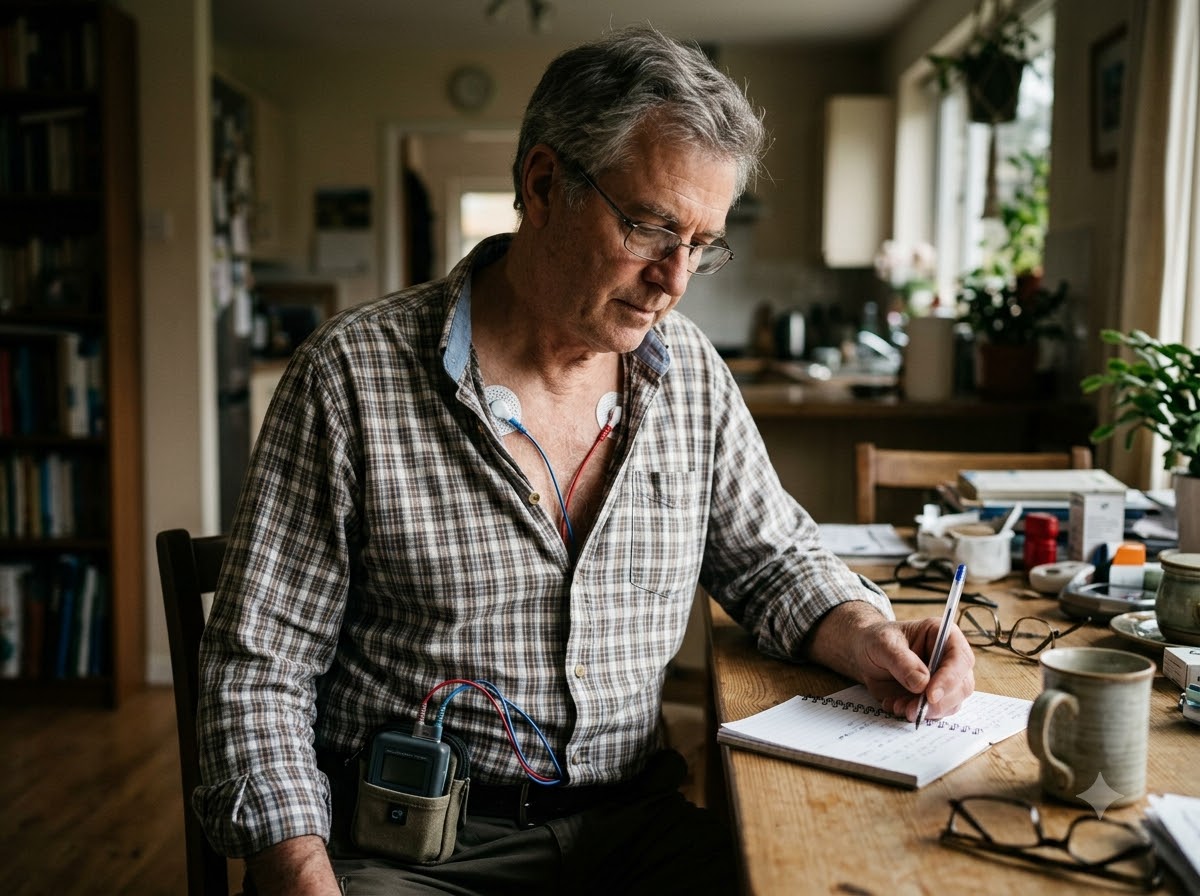
The key test for rhythm problems. A small recorder is worn while you go about your normal day, so it catches episodes a short ECG would miss. Keep a small diary of when you felt something.
Read about Holter2D Echocardiography
Checks whether the heart structure, pumping or valves are behind the rhythm problem. Essential before deciding on any treatment.
Read about 2D EchoTMT (Treadmill Test)
Shows whether the rhythm problem appears specifically during exertion, which changes both the diagnosis and the treatment.
Read about TMT24-Hour BP Monitoring
Often done alongside Holter, because blood pressure swings and rhythm problems frequently travel together.
Read about BP MonitoringEPS (Electrophysiology Study)
The definitive test. Thin wires are passed to the heart to map exactly where the faulty electrical circuit sits. If a faulty spot is found, it can be treated in the same sitting with ablation.
Read about EPS & RFAHow Is Arrhythmia Treated?
Not every irregular beat needs treating — most palpitations turn out to be harmless. The purpose of testing is to separate the harmless from the serious. Treatment depends entirely on which type you have.
Remove the trigger — start here, always
Cut down tea, coffee and energy drinks. Stop tobacco and alcohol. Correct low haemoglobin, low potassium and thyroid problems. Fix sleep. In a large number of patients, especially younger ones with palpitations, this alone settles the rhythm and no medicine is ever needed.
Medicines — to control rate, rhythm and clot risk
Rate-control tablets slow a racing heart. Rhythm-control medicines try to hold a normal beat. In atrial fibrillation a blood thinner is often added, and this is the most important part — it is what prevents a stroke. Never stop a blood thinner on your own without asking your cardiologist.
RF ablation — a permanent correction for many fast rhythms
During an EPS, once the faulty electrical pathway is located, it is sealed off using controlled radiofrequency energy through the same catheter. For several types of fast arrhythmia this is close to a permanent cure, and many patients come off medicines afterwards.
Pacemaker — for a heart that is beating too slowly
A small device placed under the skin below the collarbone, with thin wires to the heart. It watches your rhythm continuously and gives a gentle electrical prompt only when the heart is too slow. It does not take over your heartbeat; it simply prevents it from dropping dangerously low.
ICD or CRT — for high-risk patients
If the heart pumping is weak or there is a risk of a dangerous rhythm, an ICD can detect it and correct it automatically. CRT helps the two sides of a weakened heart beat together again. These are advised only for specific patients, after careful assessment.
The honest position: most people who come to us with palpitations leave with reassurance and a lifestyle correction, not a device. The purpose of the tests is to be sure. Once we know the type, the treatment is usually straightforward and very effective.
Rhythm Procedures Available in Raipur
All of these are done in our Cath Lab. None of them involves opening the chest.
EPS + RF Ablation
Maps the faulty electrical circuit and seals it in the same sitting. For many fast rhythms this is a near-permanent correction.
Learn morePermanent Pacemaker (PPI)
Single or dual chamber. The definitive treatment for a dangerously slow heartbeat and for repeated blackouts.
Learn moreICD Implantation
Detects a dangerous rhythm and corrects it automatically. Advised for patients at risk of sudden cardiac arrest.
Learn moreCRT-P / CRT-D
Helps both sides of a weakened heart beat together again, improving pumping and breathlessness in selected patients.
Learn moreDevice Check & Programming
Existing pacemakers and ICDs are checked and reprogrammed at follow-up, and battery life is tracked.
Learn moreCoronary Angiography
Done when a rhythm problem may be caused by an underlying blockage that needs treating first.
Learn moreWhy Choose Prathmesh as Your Heart Rhythm Specialist in Raipur
Rhythm problems are won by catching the episode and reading it correctly. Equipment and experience decide both.
DM Cardiology consultants
Your Holter is read and your device implanted by the senior consultant himself, not delegated to junior staff.
EPS and RF ablation in-house
The faulty circuit can be mapped and treated in the same sitting, instead of being referred to another city.
24x7 CCU monitoring
Dangerous rhythms need watching, not waiting. Continuous monitoring is available around the clock.
Honest, need-based advice
If your palpitations are harmless, we will say so plainly. Not every fluttering heart needs a device or lifelong medicine.
Complete care under one roof
ECG, Holter, echo, EPS, device implantation and lifelong device follow-up, all in one place in Raipur.
Long-term device follow-up
A pacemaker is not a one-time event. Regular checks and battery tracking close to home make that far easier to keep up.
Who Will Treat You
Your case is handled directly by one of our senior cardiologists. You can read their full profile before your visit.
800 × 1000 px · JPG

Dr. Gaurav Tripathi
Performs EPS, RF ablation and device implantation, along with emergency and complex coronary intervention.
800 × 1000 px · JPG

Dr. Sulabh Chandrakar
Focuses on rhythm disorders, pacemaker and ICD implantation, device follow-up and preventive heart care.
Questions Patients Ask Us Most
In most people the reason is harmless extra or skipped beats, often triggered by too much tea or coffee, stress, poor sleep, alcohol or tobacco. Sometimes the cause is a thyroid problem, low haemoglobin or low potassium, which a blood test can find. Less often, the rhythm problem comes from the heart itself — an old heart attack scar, a valve problem, a weak heart or an extra electrical pathway present since birth. An ECG and Holter usually tell which group you are in.
An irregular heartbeat happens when the heart’s electrical signal fires too fast, too slow, from the wrong place or through a short-circuit path. Reversible triggers include caffeine, alcohol, tobacco, thyroid problems, low potassium or magnesium, anaemia, lack of sleep and some medicines. Fixed causes include increasing age, damage from a previous heart attack, valve disease, cardiomyopathy and an extra pathway present since birth.
Usually not. Occasional extra or skipped beats are very common in healthy people. Some arrhythmias do matter, though — atrial fibrillation raises the risk of stroke, a very slow heartbeat can cause blackouts, and some fast rhythms from the lower chambers can be life-threatening. Testing is how a harmless rhythm is separated from a serious one.
See a doctor if palpitations are frequent, last more than a few minutes, or come with dizziness, breathlessness or chest discomfort. Also get checked if you have a known heart problem, or a family history of sudden cardiac death. Fainting or near-fainting, or palpitations with chest pain or severe breathlessness, need emergency care, not an OPD appointment.
Diagnosis starts with an ECG, and if the rhythm is not caught on it, a Holter monitor records your heartbeat for 24 to 48 hours of normal routine. A 2D Echo checks whether the heart structure or valves are behind the problem, and blood tests check thyroid, haemoglobin and electrolytes. A TMT is used when symptoms appear on exertion, and an EPS maps the faulty circuit when ablation is being considered.
Yes, if the arrhythmia is happening while the ECG is being recorded. The difficulty is that an ECG records only a few minutes, and many rhythm problems come and go. That is why a normal ECG does not rule out an arrhythmia, and a Holter monitor is often the next step.
A Holter monitor is needed when you get palpitations, dizziness or blackouts that come and go and were not caught on a normal ECG. It is also used to check how well rhythm medicines are working, to look for silent atrial fibrillation, and to check a slow heartbeat before deciding on a pacemaker. You wear it for 24 or 48 hours and note down when you felt something.
Treatment depends on the type. Many people only need triggers removed — less tea and coffee, no tobacco or alcohol, better sleep, and correction of thyroid or low haemoglobin. Others need medicines to control the rate or rhythm, plus a blood thinner in atrial fibrillation. Some fast rhythms are corrected with RF ablation, and a dangerously slow heartbeat is treated with a pacemaker.
No. It is not open-heart surgery. The device is placed under the skin below the collarbone through a small cut, under local anaesthesia, and you stay awake. It usually takes about an hour, and most patients go home the next day and resume normal activity within a couple of weeks.
For several types of fast rhythm, yes — it comes close to a permanent cure, and many patients stop their medicines afterwards. For atrial fibrillation the results are good but it can sometimes return, and a repeat procedure may be needed. Your cardiologist will tell you honestly which group your rhythm falls into before you decide.
Because the main danger is not the symptom, it is the stroke risk. In AFib the upper chambers quiver instead of beating, so blood can pool and form a clot that can travel to the brain. This is why a blood thinner is often more important than the medicine controlling the heart rate. Never stop a blood thinner on your own — any change must be decided by your cardiologist.