
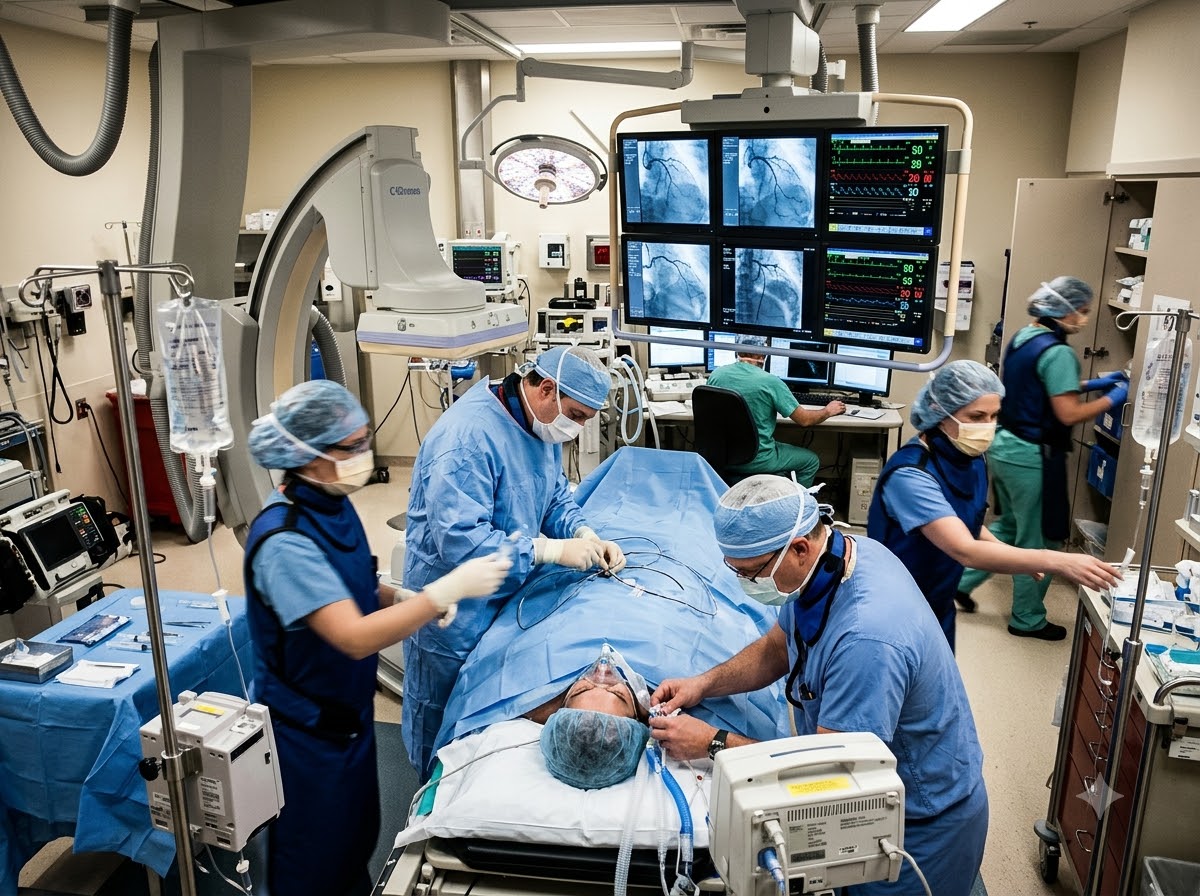
What Exactly Happens in a Heart Attack?
Three arteries sit on the surface of your heart and supply it with blood. Over the years, fat and cholesterol build up inside their walls and form a layer called plaque.
A heart attack does not usually happen because the artery slowly closed to 100%. It happens because one of these plaque layers suddenly cracks. The moment it cracks, the body treats it like a wound and forms a clot over it. That clot can shut the artery completely within minutes. Doctors call this a myocardial infarction (heart muscle damage from lack of blood). It belongs to a group of cardiac emergencies called acute coronary syndrome.
This is why a heart attack feels sudden. Many patients say "but I was perfectly fine yesterday". That is normal and it is true. A 40% blockage that was causing no symptom at all can crack and close the artery in a few minutes. That is also why a person who passed a check-up last year can still have an attack this year.
Why the first hour decides everything
Once the artery closes, the heart muscle beyond it starts dying. In the first hour, almost all of it can still be saved if blood flow is restored. After 6 hours, a large part of that muscle is permanently gone and cannot be brought back — which is what leads to long-term weakness of the heart later.
This is the single most important fact on this page: the treatment is the same whether you come in 1 hour or 6 hours. What changes is how much of your heart survives.
What Causes a Heart Attack, and Who Is at Risk?
A heart attack is the end result of years of quiet damage to the arteries. These are the factors that build that damage.
You can control these
- Tobacco in any form — the single biggest avoidable cause
- Diabetes that is not well controlled
- High blood pressure left untreated
- High cholesterol
- Belly fat and lack of physical activity
- Stopping heart medicines on your own once you "feel fine"
- Long-term stress and poor sleep
You cannot control these
- Increasing age
- A parent or sibling who had an early heart attack
- Having had a previous heart attack, stent or bypass
- South Asian origin — heart attacks happen roughly a decade earlier than in Western populations
Heart attacks in the 30s and 40s are no longer rare in India. Young age alone is not protection.
What Are the Warning Signs of a Heart Attack?
A heart attack does not always look like it does in films. Very few people clutch their chest and collapse. Most walk in saying it felt like gas, or like a heavy weight.
Classic heart attack symptoms
- Sudden chest pain, heaviness, pressure or tightness in the centre of the chest lasting more than 10–15 minutes, and not settling with rest
- Pain spreading to the left arm, both arms, jaw, neck, shoulder or upper back
- Cold sweating with a strong feeling of restlessness or fear
- Severe breathlessness, even while sitting still
- Nausea or vomiting along with chest discomfort
- Sudden dizziness, fainting or collapse
- The signs people miss: in women, in people with diabetes and in the elderly, there is often no chest pain at all — only sudden extreme weakness, breathlessness with unusual sweating, upper stomach discomfort that feels exactly like acidity, or jaw, back or shoulder pain with no chest symptom.
The safest rule for a family to follow: if someone above 40, or anyone with diabetes, blood pressure or a family history, suddenly feels unwell in a way they have never felt before — get an ECG. It takes five minutes and costs very little. A wasted ECG is a small loss. A missed heart attack is not.
Emergency signs — do not wait, call now
If any of these are present, treat it as a heart attack until proved otherwise. Call first, then move — do not drive the patient yourself.
- Chest heaviness or pain lasting more than 10–15 minutes
- Chest discomfort that continues even while sitting or resting
- Cold sweating with restlessness, fear or a feeling that something is very wrong
- Severe breathlessness, with or without chest pain
- Vomiting or upper stomach discomfort along with sweating
- Fainting, collapse or sudden loss of consciousness
How Is a Heart Attack Diagnosed?
In an emergency, diagnosis is fast. The first two tests are usually done within minutes of arrival, and treatment can begin before every report is back.
ECG — done first, within minutes
Stickers on the chest record the heart’s electrical activity. It can show an ongoing heart attack immediately and tells the team which artery is likely blocked.
Read about ECGTroponin blood test (cardiac enzymes)
When heart muscle is damaged it releases a protein called troponin into the blood. A raised level confirms the attack and shows roughly how much muscle is affected.
All diagnostic tests2D Echocardiography
An ultrasound of the heart that shows which part of the muscle has stopped moving properly, and how strong the pumping still is.
Read about 2D EchoEmergency Coronary Angiography
In a confirmed heart attack this is not a separate appointment — the patient goes straight to the cath lab. The blocked artery is found and opened in the same sitting.
Read about AngiographyHow Is a Heart Attack Treated?
There is only one goal in the first few hours: reopen the blocked artery as fast as possible. How that is done depends on how much time has passed and what facility is available.
Primary angioplasty — the preferred treatment
The patient is taken directly to the cath lab. A thin tube goes in through the wrist, the clot and blockage are found, a balloon opens the artery and a stent holds it open. Blood flow is restored within minutes. When it can be done in time, this gives the best outcome of any treatment for a heart attack.
Clot-dissolving injection (thrombolysis)
If a cath lab cannot be reached quickly, a medicine is given through the vein to dissolve the clot. It helps, but it works in fewer patients than angioplasty and carries a bleeding risk. It is a bridge, not the ideal option — which is exactly why reaching a cath lab directly matters.
CCU care and medicines
After the artery is opened, the patient stays in the CCU under continuous monitoring, because the first 48 hours carry a risk of rhythm problems. Blood thinners, cholesterol medicines and heart-protective tablets are started and usually continue lifelong.
Bypass surgery, if the anatomy demands it
Sometimes the angiography shows that all three arteries are severely diseased. In that situation bypass surgery may be planned once the patient is stable, rather than placing multiple stents.
About recovery: after a heart attack, most people can return to a normal life — work, walking, travel, family life. What decides that is not luck. It is how quickly the artery was opened, and how honestly the medicines, heart attack follow-up visits, cardiac rehabilitation and lifestyle changes are maintained afterwards. Stopping tablets once you feel well is the most common reason for a second attack.
Procedures Used in Heart Attack Care
What is needed depends on which artery closed, how long ago, and what the attack has left behind.
Primary Angioplasty
Emergency angioplasty during an ongoing heart attack. The fastest way to restore blood flow and save heart muscle.
Learn moreCoronary Angiography
Finds the exact artery that has closed, so treatment happens in the same sitting.
Learn moreAngioplasty & Stenting
Balloon and stent to open the blocked artery. No chest cut, local anaesthesia only.
Learn moreIVUS & FFR Guided PCI
Imaging from inside the artery so the stent is sized and placed accurately.
Learn moreCTO Angioplasty
For an artery that has stayed completely closed since an earlier, untreated attack.
Learn morePacemaker / ICD
If the attack has damaged the heart’s rhythm or pumping, a device may be advised to protect against sudden collapse.
Learn moreWhy Choose Prathmesh as Your Heart Attack Hospital in Raipur
In a heart attack, the hospital you reach in the first hour matters more than almost anything else.
Cath lab team available 24x7
A heart attack at 2 AM gets the same response as one at 2 PM. The team is called in while the patient is still on the way.
Emergency angioplasty by the consultant
The procedure is done by the DM Cardiology consultant himself, not handed to junior staff at night.
3D Cath Lab with IVUS & FFR
Accurate assessment even in a rushed emergency, so the right artery is treated the right way the first time.
Fully equipped CCU
Continuous monitoring through the critical first 48 hours, when rhythm problems are most likely.
Close to home in Raipur
Travelling 4 to 6 hours to another city during an attack costs muscle that never comes back. Distance itself is a risk factor.
Clear communication with the family
Someone explains to the family what is happening and why, in plain language, before consent is taken.
Who Will Treat You
Your case is handled directly by one of our senior cardiologists. You can read their full profile before your visit.
800 × 1000 px · JPG
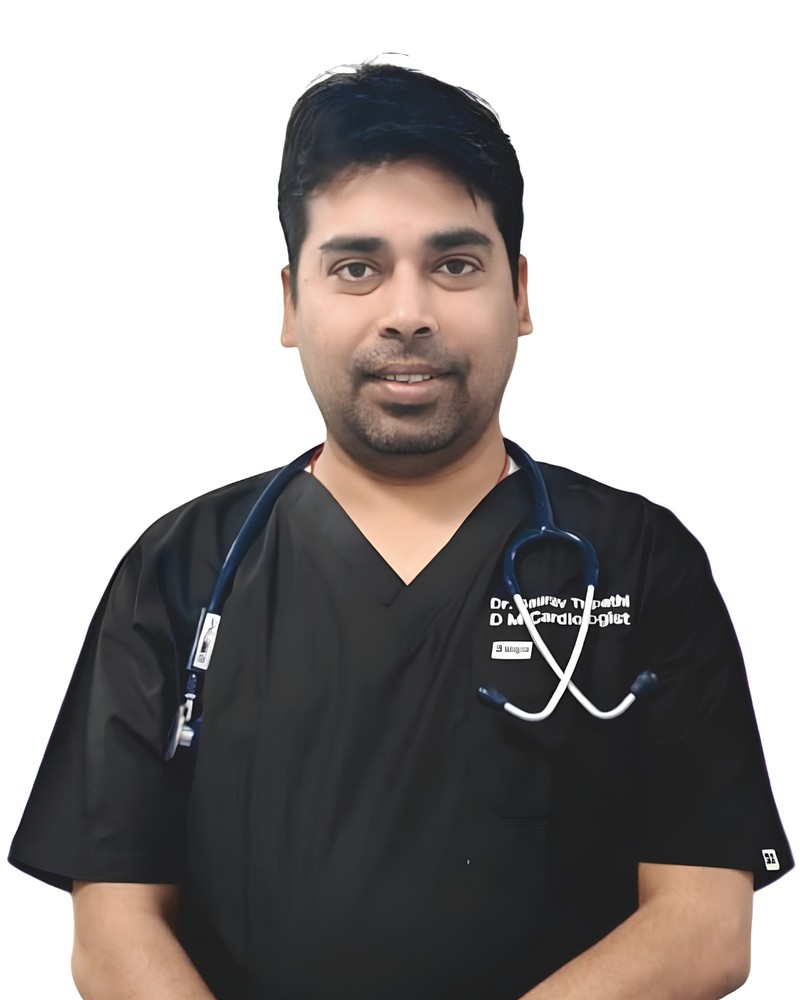
Dr. Gaurav Tripathi
Performs emergency and primary angioplasty, complex and CTO cases, with IVUS and FFR guided decision making.
800 × 1000 px · JPG
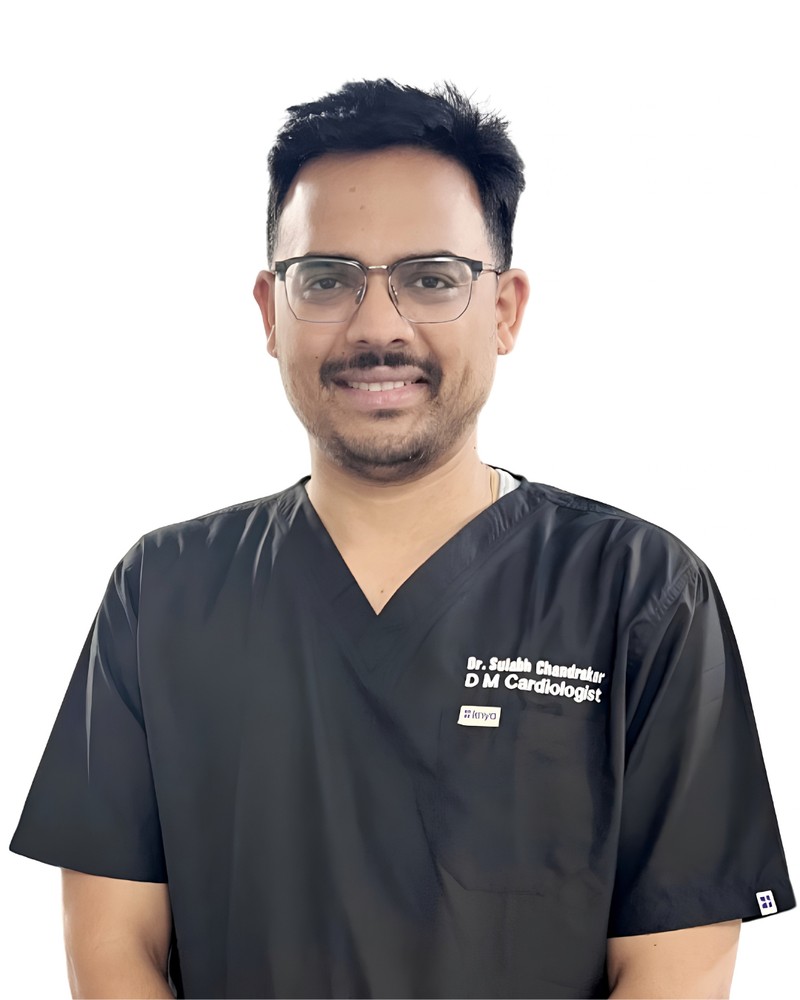
Dr. Sulabh Chandrakar
Manages post-attack recovery, rhythm problems, device implantation and long-term prevention of a second attack.
Questions Patients Ask Us Most
The classic sign is heaviness, pressure or tightness in the centre of the chest lasting more than 10 to 15 minutes, often spreading to the left arm, jaw, neck or back. It may come with cold sweating, breathlessness, nausea or a feeling of fear. In women, people with diabetes and the elderly, the only signs may be sudden weakness, breathlessness or acidity-like discomfort. If in doubt, get an ECG immediately.
Call us on +91 77778 65621 immediately and tell us the symptoms, so the cath lab team can be ready before you arrive. Sit the person down, loosen tight clothes, and if they are conscious and not allergic, have them chew one 325 mg aspirin. Do not let them walk, do not drive yourself, and do not wait to see if the pain settles.
Yes. A plaque that was causing no symptoms can suddenly crack and a clot can close the artery within minutes, so many people have no warning before the attack. A silent heart attack, without chest pain, is also common in people with diabetes, in women and in the elderly. Any sudden, unusual feeling of being very unwell in a person at risk should be checked with an ECG.
Most heart attacks happen when a plaque of fat and cholesterol inside a coronary artery cracks and a blood clot forms over it, blocking blood flow to the heart muscle. The plaque builds up over years because of tobacco, diabetes, high blood pressure, high cholesterol, belly fat and inactivity. Age, family history and South Asian origin also raise the risk.
An ECG is done within minutes of arrival and can show an ongoing heart attack immediately. A troponin blood test (cardiac enzymes) confirms heart muscle damage, and a 2D Echo shows which part of the heart has stopped moving properly. In a confirmed attack, emergency coronary angiography finds the blocked artery so it can be opened in the same sitting.
The goal is to reopen the blocked artery as fast as possible. Primary angioplasty — a balloon and stent placed through the wrist — is the preferred treatment when it can be done in time. If a cath lab is not reachable quickly, a clot-dissolving injection may be given first. After that the patient is monitored in the CCU and started on long-term heart medicines.
Before discharge, a 2D Echo checks how strong the pumping is, and repeat ECGs and blood tests check the rhythm, cholesterol, sugar and kidney function. During follow-up, the echo may be repeated, and a TMT or Holter may be advised to check exercise capacity or rhythm problems. Your cardiologist will decide which tests you need based on how the attack affected your heart.
Most patients stay in hospital 3 to 5 days, including CCU monitoring. Light activity begins within days, desk work often resumes in 2 to 4 weeks, and heavy physical work later, as advised. The heart muscle takes a few weeks to heal, and a gradual, supervised return to activity (cardiac rehabilitation) helps you regain strength safely.
The golden hour is the first 60 minutes after symptoms start. If the artery is opened in this window, almost all of the heart muscle can be saved. Treatment still helps for several hours afterwards, so never assume it is too late — but the longer the delay, the more muscle is permanently lost, and that is what causes long-term heart weakness.
No. This is one of the most common and most costly mistakes. A local clinic cannot open a blocked artery, and the time spent there is time the heart muscle is dying. Come directly to a hospital with a cath lab, or call us and we will guide you on the phone while you travel.
A stent fixes one blocked spot; it does not cure the underlying disease. Take every prescribed medicine daily without a break, even when you feel completely fine, and stop tobacco entirely. Keep BP, sugar and cholesterol at the targets your doctor sets, walk 30 to 40 minutes on most days once cleared, and attend every follow-up.