
What is Peripheral Artery Disease?
Peripheral artery disease (also called peripheral arterial disease or peripheral vascular disease), or PAD, means the arteries carrying blood to your arms and legs — most often the legs — have become narrow or blocked. In plain words, the nerves people talk about are actually arteries, and they have silted up.
The cause is the same process that blocks heart arteries: atherosclerosis, the slow build-up of cholesterol, fat and calcium inside the artery wall. Muscles need extra blood when they work. When the supply pipe is narrowed, this reduced blood flow means the calf muscle gets enough blood while you are resting but starves the moment you start walking — and that starvation is felt as pain.
Think of a garden pipe with silt collecting inside it. At a slow trickle, the water still reaches the plants. But the moment you open the tap fully and demand more, the flow is not enough. Your calf muscle is that plant: fine when you are sitting, starved when you walk. That is why the pain of peripheral artery disease appears on walking and disappears on standing still.
Why does this matter beyond the leg?
This is the part patients are rarely told. If cholesterol has blocked the arteries of your legs, the same process is almost certainly happening in the arteries of your heart and brain. Peripheral artery disease is a warning sign for the whole body.
That is why a leg artery blockage is never treated as a leg problem alone. A full cardiac assessment is part of proper treatment — many patients discover a silent heart blockage at this stage, while it is still easy to treat. Leg pain, in that sense, can be a lucky early warning.
Why Do Leg Arteries Get Blocked?
Peripheral artery disease develops over years. Most of the reasons behind it can be controlled, which is why early diagnosis changes so much.
You can control these
- Smoking, tobacco, gutkha and khaini — by far the strongest cause; smokers develop PAD far earlier and far more severely
- Diabetes, especially when sugar has been uncontrolled for years — the single biggest risk factor in India after tobacco
- High blood pressure damaging the artery lining over time
- High cholesterol and high triglycerides
- Obesity and a completely sedentary routine
- Kidney disease, particularly in patients on dialysis
- Untreated high homocysteine levels
- Ignoring a small foot wound or callus until it turns into an ulcer
You cannot control these
- Age above 50, and much more commonly above 65
- Being male, though risk in women rises sharply after menopause
- Family history of early heart attack, stroke or leg artery blockage
- A past heart attack, angioplasty or stroke — the same disease in another artery
- Long-standing type 1 diabetes
If you smoke or chew tobacco and have leg pain on walking, please understand this clearly: stopping tobacco does more for your legs than any medicine or procedure. Patients who continue after an angioplasty often block the artery again within months.
What Are the Symptoms of PAD?
The symptoms follow a very recognisable pattern, and once you know the pattern it is hard to miss. The trouble is that almost everyone blames it on age, weakness or a nerve problem.
Leg pain while walking and other signs of poor blood circulation in legs
- Cramping pain in the calf, thigh or hip that starts after walking a certain distance and goes away within two or three minutes of standing still. The distance is usually consistent — "I can walk to the corner shop, then I have to stop." This is the classic symptom, called claudication.
- The walking distance shrinking over months — first 500 metres, then 200, then to the gate. This worsening pattern matters more than the pain itself.
- One foot or leg that feels colder than the other, to your own touch or to someone else's
- Numbness, tingling or heaviness in the leg, often mistaken for a nerve or spine problem
- Skin on the leg becoming shiny, thin and hairless; toenails growing slowly and becoming thick
- A cut, blister or crack on the foot or toe that simply will not heal for weeks
- Pale or bluish colour of the foot, especially when it is raised
- Pain in the foot at night, in bed, that eases when you hang the leg down or sit up
- Weak muscles in the leg and visible thinning of the calf
The single most important distinction: pain from a blocked artery comes on with walking and settles with rest. Pain from a spine or nerve problem often continues at rest, changes with posture, and travels down the leg with a shooting or burning quality. Many patients spend years in orthopaedic treatment for what is actually an artery blockage. If your pain is a reliable "walk-stop-relief" pattern, please get your leg arteries checked.
Emergency signs — do not wait, call now
These signs mean the blood supply to the leg is critically low. Reaching a cardiac centre within hours, not days, decides whether the leg can be saved.
- Sudden severe pain in the leg with the leg turning cold, pale or blue
- Sudden inability to move or feel the leg or foot
- A foot wound or toe turning black
- A foot wound with foul smell, spreading redness or fever
- Constant rest pain in the foot that no longer settles at all
- No pulse felt at the ankle or foot
What Tests Are Used for PAD?
The first two leg artery tests are painless, quick and inexpensive. They usually settle the diagnosis before anything invasive is considered.
ABI (Ankle-Brachial Index)
Blood pressure is measured at your arm and at your ankle and the two are compared. A low ankle reading means the blood is not reaching the foot properly. Simple, painless, and often the first test that confirms PAD.
All diagnostic testsLeg Artery Test: Colour Doppler
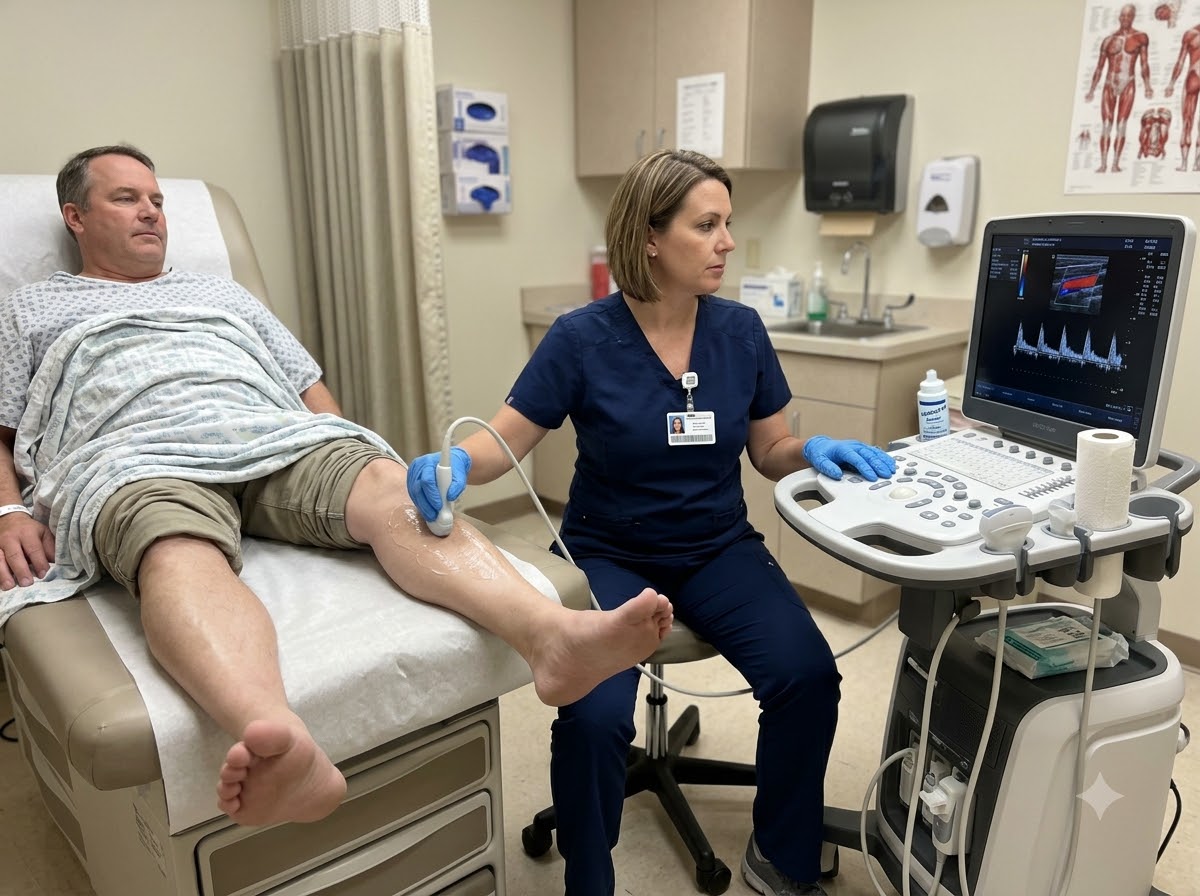
An ultrasound of leg circulation that shows the blood flowing through your leg arteries and pinpoints where it has narrowed. No needles, no radiation — a probe with gel moved over the leg.
Read about DopplerPeripheral Angiography
A dye study of the leg arteries that maps the exact site and length of each blockage. This is what decides whether angioplasty is possible and where the balloon must go.
Read about AngiographyBlood Tests
Sugar, HbA1c, cholesterol profile, kidney function and haemoglobin. These find the reasons behind the blockage and are needed before any procedure.
All diagnostic testsCT Angiography
A detailed scan of the leg arteries used when the Doppler is unclear or when planning a complex case. Needs a dye injection into a vein.
All diagnostic testsCardiac Assessment (ECG, Echo)
Because blocked leg arteries usually mean the heart arteries are at risk too, a heart check with an ECG and 2D Echo is part of a complete PAD assessment — not an extra test.
Heart blockage pageCan Blocked Leg Arteries Be Treated?
In the large majority of cases, yes — and increasingly without open surgery. Leg arteries can now be opened with a balloon and stent through a small puncture, the same way heart arteries are treated. What decides the outcome is how early the patient comes.
Stop tobacco completely — this is the treatment, not advice
Nothing else in this list works properly while tobacco continues. Smoking and chewing tobacco constrict the arteries and accelerate the blockage, and they are the commonest reason a treated leg artery blocks again. Patients who stop often notice their walking distance improving within weeks, before any procedure.
Supervised walking — the treatment patients underestimate
Walking until the pain starts, resting until it settles, then walking again — repeated daily for thirty to forty-five minutes — genuinely improves walking distance over two to three months. It encourages small side channels to develop around the blockage. It sounds too simple to matter, and it is one of the most effective things you can do.
Medicines to protect the artery
Blood-thinning medicines to prevent a clot forming on the narrowed patch, cholesterol-lowering medicines to stabilise the deposit, and tight control of sugar and blood pressure. Some patients are also given medicines that specifically improve walking distance. These are long-term medicines, not a short course.
Angioplasty and stenting of the leg artery
A thin wire is passed to the blockage, a balloon opens it, and a stent is often placed to hold the artery open. It is done through a small puncture in the groin or arm under local anaesthesia — you stay awake, and most patients go home the same day or the next. This is the usual treatment when pain is limiting life, or when there is rest pain or a wound that will not heal.
Bypass surgery, when the blockage is unsuitable for a balloon
For very long or heavily calcified blockages, a surgical bypass routes blood around the blocked segment. It remains an excellent option in the right patient, and the choice between angioplasty and bypass is made from the angiography findings, not by preference.
Foot care and wound management
For patients who already have an ulcer, opening the artery is only half the job. The wound needs proper dressing, infection control and pressure relief, along with diabetes control, before it will heal. Daily foot inspection becomes a lifelong habit.
Honest answer to the question every patient asks: no, not every leg blockage needs a stent. Many patients with mild claudication do very well on tobacco cessation, a walking programme and medicines, and are simply followed up. A procedure is advised when the pain genuinely limits your daily life, or when there is rest pain, a non-healing wound or a critically low blood supply. If someone advises a stent for mild pain without trying the basics first, it is entirely reasonable to ask why.
Peripheral Artery Procedures Available in Raipur
All of these are available at Prathmesh. Which one applies depends on where the blockage is, how long it is, and how much blood is still reaching the foot.
Peripheral Angiography
Maps every blockage in the leg arteries and decides the exact treatment plan. Done awake, through a small puncture.
Learn moreLeg Angioplasty & Stenting
Opens the blocked leg artery with a balloon and holds it open with a stent — no open surgery, usually same-day or next-day discharge.
Learn moreBalloon Angioplasty of Below-Knee Arteries
For blockages in the smaller arteries below the knee, often the key to healing a diabetic foot wound and saving the limb.
Learn moreThrombolysis / Clot Removal
For a sudden artery blockage by a clot, where the leg has turned cold and pale and every hour counts.
Learn moreColour Doppler Study
The painless ultrasound that locates the narrowing and is also used to follow the artery up after treatment.
Learn moreCoronary Angiography
Checks the heart arteries in the same patient, because leg and heart blockages travel together far more often than people expect.
Learn moreWhy Choose Prathmesh for Peripheral Artery Disease Treatment in Raipur
Peripheral artery disease is where a delay of weeks can cost a limb. Being treated close to home, by a team that also assesses the heart, matters.
DM Cardiology interventional team
Leg angioplasty is performed by the senior interventional cardiologist, in a fully equipped cath lab, with the same discipline applied to heart procedures.
Heart and leg assessed together
A patient with a leg blockage is screened for silent heart disease in the same visit. Several patients discover a treatable coronary blockage at this point.
Limb salvage focus
The aim in every case, including diabetic foot wounds, is to restore blood flow and save the limb. Amputation is the last resort, not an early suggestion.
Painless tests first
ABI and colour Doppler come before anything invasive. An angiography is advised only when the treatment plan genuinely depends on it.
Diabetic foot co-management
Sugar control, wound care and artery treatment handled together, because a wound will not heal if any one of the three is ignored.
Follow-up in Raipur
Doppler review, medicine adjustment and foot checks continue locally, without a trip to a metro city every few months.
Who Will Treat You
Your case is handled directly by one of our senior cardiologists. You can read their full profile before your visit.
800 × 1000 px · JPG

Dr. Gaurav Tripathi
Performs peripheral angiography and leg artery angioplasty, including below-knee work for diabetic foot cases.
800 × 1000 px · JPG

Dr. Sulabh Chandrakar
Assesses risk factors, manages medicines, sugar and cholesterol, and supervises walking programmes and long-term follow-up.
Questions Patients Ask Us Most
Peripheral artery disease, or PAD, means the arteries carrying blood to the legs (and sometimes the arms) have become narrow or blocked. The cause is atherosclerosis, the slow build-up of cholesterol, fat and calcium inside the artery wall, the same process that blocks heart arteries. It reduces blood flow to the leg muscles, especially while walking.
The classic symptom is a cramping pain in the calf, thigh or hip that starts after walking a certain distance and settles within a few minutes of standing still. Other signs are one foot colder than the other, numbness in the legs, shiny hairless skin, slow-growing toenails and a foot wound that does not heal. Severe PAD causes foot pain at night or at rest.
If the pain comes on reliably after a certain distance and goes away within two or three minutes of rest, a narrowed leg artery is very likely: the muscle gets enough blood at rest but not during exercise. Pain that continues at rest, changes with posture or shoots down the leg with burning is more often a spine or nerve problem. An ABI and a colour Doppler settle the question painlessly.
The doctor first asks about the walking pattern and checks the pulses in your feet. An ABI then compares the blood pressure at the ankle and the arm, and a colour Doppler ultrasound shows exactly where the artery has narrowed. Angiography is done only when a procedure is being planned.
Yes. Mild cases improve with stopping tobacco, a daily walking programme and medicines for blood thinning, cholesterol, sugar and blood pressure. When pain limits daily life or a wound will not heal, the artery can be opened by leg angioplasty and stenting through a small puncture under local anaesthesia, usually with same-day or next-day discharge. Bypass surgery is kept for very long or heavily calcified blockages.
The main tests are the ABI (ankle-brachial index) and a colour Doppler of the legs, both painless and without radiation. Blood tests check sugar, HbA1c, cholesterol and kidney function. CT angiography or peripheral angiography map the blockage before treatment, and an ECG and echo check the heart, because heart blockages often travel with leg blockages.
It can be. Poor circulation from blocked arteries can lead to wounds that do not heal and, if ignored for long, risk to the limb. It is also a warning that the arteries of the heart and brain may be affected. Detected early, it is very treatable, so cold feet, leg pain on walking or slow-healing wounds should be checked.
See a specialist if your legs hurt every time you walk a certain distance, if your walking distance is shrinking, or if a foot wound has not healed in a couple of weeks, especially with diabetes. Smokers and diabetics with numbness or cold feet should also be checked. Sudden severe leg pain with a cold, pale leg or a toe turning black is an emergency.
In everyday Hindi the word "nas" is used for both, and this causes real confusion. In peripheral artery disease it is an artery — the pipe carrying blood to your leg — that has narrowed, not a nerve. The treatment is completely different, which is why getting this right early matters so much.
Uncontrolled sugar is part of it, but a wound that refuses to heal for weeks very often means the blood supply to the foot is inadequate as well. No dressing and no antibiotic will heal a wound that is not getting enough blood. Please get an ABI and a leg Doppler done, because restoring the blood supply is frequently what finally allows the wound to close.
For the large majority of patients, no. Amputation becomes a risk mainly when a patient comes very late — with a black toe, a deep infected wound, or a leg that has lost its blood supply for days. When blood flow is restored in time, most limbs are saved, which is why leg pain and non-healing wounds should not be watched for months.