
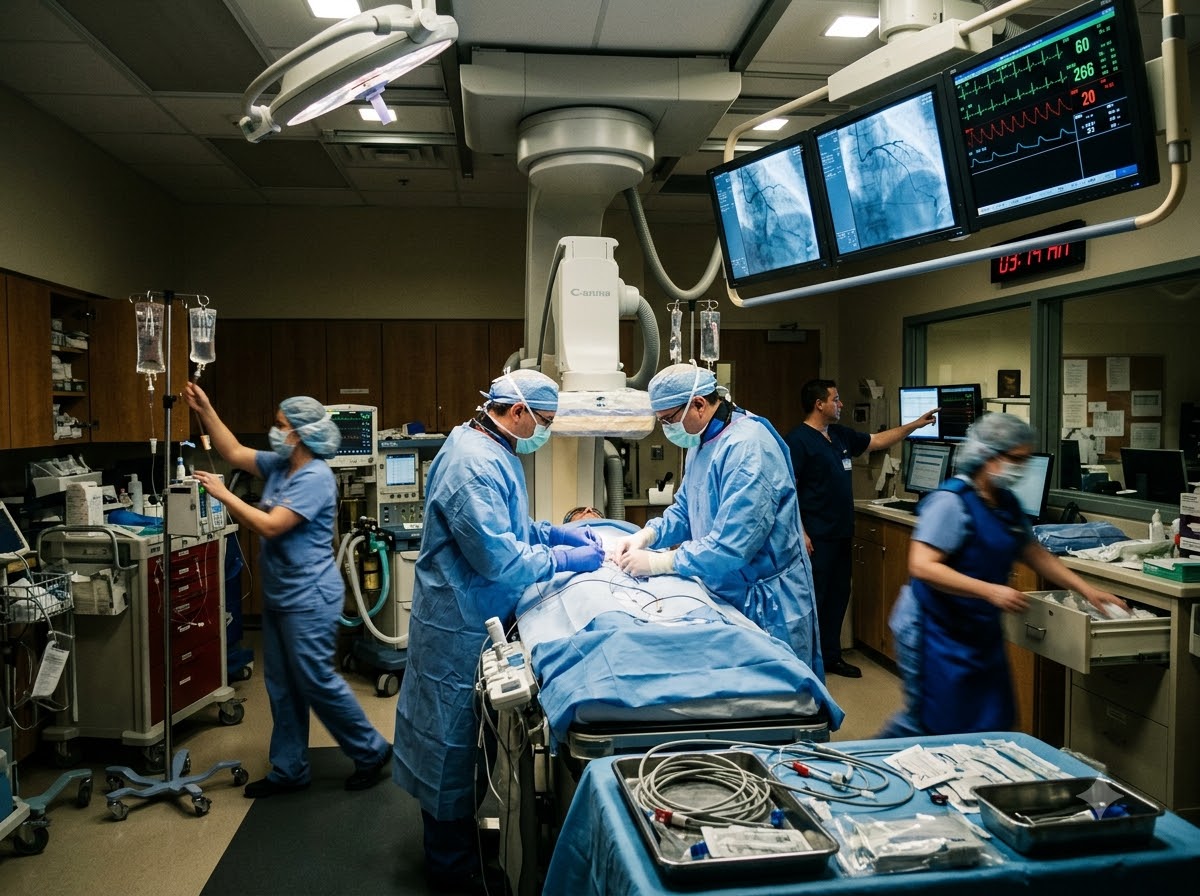
What Happened That Night
It started around 11 pm, after dinner. A heaviness in the centre of the chest — not a sharp pain, more like someone pressing down hard. He thought it was gas and took an antacid. Twenty minutes later the pressure was still there, it had started spreading to the left arm and jaw, and he was sweating even though the fan was on.
His son noticed he looked pale and restless. They did not wait for morning. They drove straight to our 24x7 cardiac emergency, about twenty minutes away. That single decision mattered more than anything we did afterwards.
He reached us roughly fifty minutes after the pain began. An ECG was taken within minutes of him walking in.
The symptoms he had — and that you should never ignore
Please note: This is a representative case built from the kind of heart attack we treat regularly. The details are illustrative and not one identifiable patient. Every heart is different, and your own treatment is decided only after your doctor examines you and sees your reports.
What the Tests Showed
In a suspected heart attack there is no time for a long list of tests. Three things are done almost together, and the decision follows within minutes.
ECG — done within minutes of arrival
The ECG showed the typical changes of an ongoing heart attack in the lower wall of the heart. This alone was enough to activate the cath lab team.
About the ECG testBlood test (troponin)
Troponin is a protein released when heart muscle is damaged. It was raised, confirming that muscle was already being lost.
2D Echo — quick bedside look
The echo showed one part of the heart wall was not squeezing properly, matching the area the ECG pointed to.
About 2D EchoCoronary angiography
Done on the cath lab table itself. Dye injected into the heart arteries showed one artery completely blocked by a clot.
About angiographyWhy the hurry? During a heart attack, heart muscle starts dying from the first minutes. The phrase doctors use is “time is muscle” — every minute the artery stays blocked, a little more of the heart is permanently lost. That is why we do not wait for all reports before starting treatment.
Why Angioplasty and Not Just Medicines
When an artery is completely blocked by a clot, the only real goal is to open it again, fast. There are two ways: clot-dissolving injections, or primary angioplasty — physically opening the artery with a balloon and stent.
Where a cath lab and a trained team are available immediately, angioplasty is the better option: it opens the artery more reliably and lets the doctor see exactly what is happening inside. Because he had reached us quickly and our cath lab was ready, this was the clear choice. The family was told what was being done and why, and consent was taken before shifting him.
What made angioplasty the right choice here
- He reached within the first few hours, while muscle could still be saved
- The angiogram showed one clearly blocked artery, suitable for a stent
- A cath lab and team were available immediately, in the same building
- He had no bleeding problem that would make the procedure risky
When the plan would have been different
- If many arteries were badly blocked — bypass surgery may be advised instead
- If the blockage was partial and stable — medicines first, tests later
- If he had reached after several days — the urgency and the plan both change
- If there was active bleeding somewhere — blood thinners become unsafe
The Procedure, Step by Step
Patients and families imagine something far more frightening than what actually happens. He was awake throughout. Here is exactly how it went.
Shifted to the cath lab
He was moved to the cath lab table and connected to monitors. Blood-thinning medicines were given at once. The family waited just outside and was updated.
Local anaesthesia at the wrist
A small injection numbs the skin at the wrist. This is the only needle prick he really felt. No cut, no general anaesthesia, no ventilator.
A thin tube reaches the heart
A fine catheter is passed from the wrist artery up to the heart. There are no pain nerves inside arteries, so this is not painful — most patients feel nothing at all.
The blockage is found
Dye is injected and the blocked artery shows up clearly on screen. He could see the monitor himself while the doctor explained what was blocked.
Balloon and stent
A balloon is opened at the blockage to push it aside, then a stent — a small metal mesh tube — is placed to hold the artery open permanently.
Blood flow restored
Dye was injected again to confirm the artery was fully open. The chest heaviness began easing on the table itself. Total time: under an hour.
What it felt like, in his words: pressure and a warm flush when the dye went in, and a strange relief as the heaviness lifted. A small bandage on the wrist afterwards, and he was able to sit up and talk to his family the same night.
Recovery, Week by Week
This is the part families ask about most, and the part most websites skip. Here is the realistic timeline.
First 24 hours — in CCU
Continuous monitoring of rhythm and blood pressure. He was allowed to sit up, eat a light diet and talk. The wrist was checked regularly.
Day 2 to 3 — ward, then home
Walking in the room and corridor. Medicines explained one by one to him and his wife, with a written list. Discharged on day three.
Week 1 to 2 — light activity at home
Short walks indoors, no lifting, no driving. Follow-up visit at one week to check the wrist, blood pressure and how he was feeling.
Week 3 to 4 — building up
Walking outdoors, gradually longer. Repeat ECG and echo. Blood sugar and cholesterol checked and medicines adjusted.
About 4 weeks — back to work
Back to his desk job and most normal activity, with medicines continuing and a clear follow-up schedule.
The medicines are not optional. After a stent, blood-thinning tablets keep the stent from clotting. Stopping them early — because he felt fine, or because someone advised it — is one of the most dangerous things a patient can do. He was told clearly: never stop these on your own, and tell any other doctor or dentist that you have a stent.
He also made the changes that actually prevent the next attack: he stopped smoking, his blood pressure and sugar are now checked regularly, and he walks daily. The stent fixed one artery; these habits protect the rest.
What This Means for You
If you take only one thing from this page, take this: the outcome was good mainly because he came early. Not because of any single piece of equipment. The same blockage, treated six hours later, is a much bigger and more permanent injury to the heart.
So if you or someone at home has chest pain that feels like pressure and does not settle in a few minutes:
- Do not wait to see if it passes, and do not wait for morning
- Do not drive yourself — have someone else drive, or call for help
- Do not take a painkiller and sleep it off; an antacid not helping is a warning sign
- Go to a hospital that has a cath lab and a cardiologist available 24x7
- Carry your old reports and medicine list if they are within reach — but never delay for them
Call us now if this is happening right now. Chest pressure with sweating, breathlessness, or pain spreading to the arm or jaw is an emergency, not something to discuss in the morning. Our cardiac emergency is open 24x7 — +91 77778 65621.
Why This Was Possible at Prathmesh
Emergency heart attack care is not about one machine. It is about the whole chain being ready at midnight.
Cath lab ready round the clock
The lab and the team can be activated at any hour, which is what primary angioplasty needs.
DM Cardiology specialists
The consultant who decides the treatment is the one who performs it — not a junior on night duty.
ECG within minutes of arrival
Any patient arriving with chest pain gets an ECG immediately, before registration formalities.
CCU in the same building
No shifting between hospitals after the procedure — monitoring continues upstairs.
Family kept informed
What is being done and why is explained in plain language before consent, and again after.
Easy to reach in Raipur
NH-30, Amlidih Road, Deopuri — reachable quickly from most of Raipur and nearby districts.
Who Will Treat You
Your case is handled directly by one of our senior cardiologists, who explains every step before it happens.
800 × 1000 px · JPG
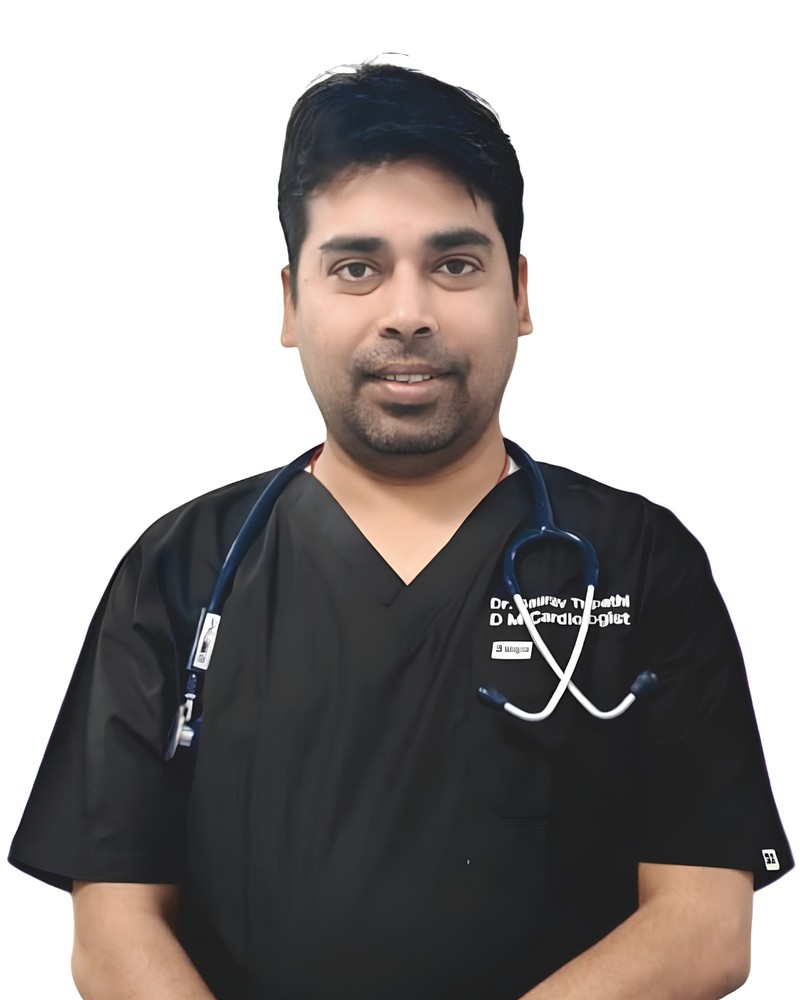
Dr. Gaurav Tripathi
Leads emergency heart attack care and performs primary angioplasty, including complex and calcified blockages.
800 × 1000 px · JPG
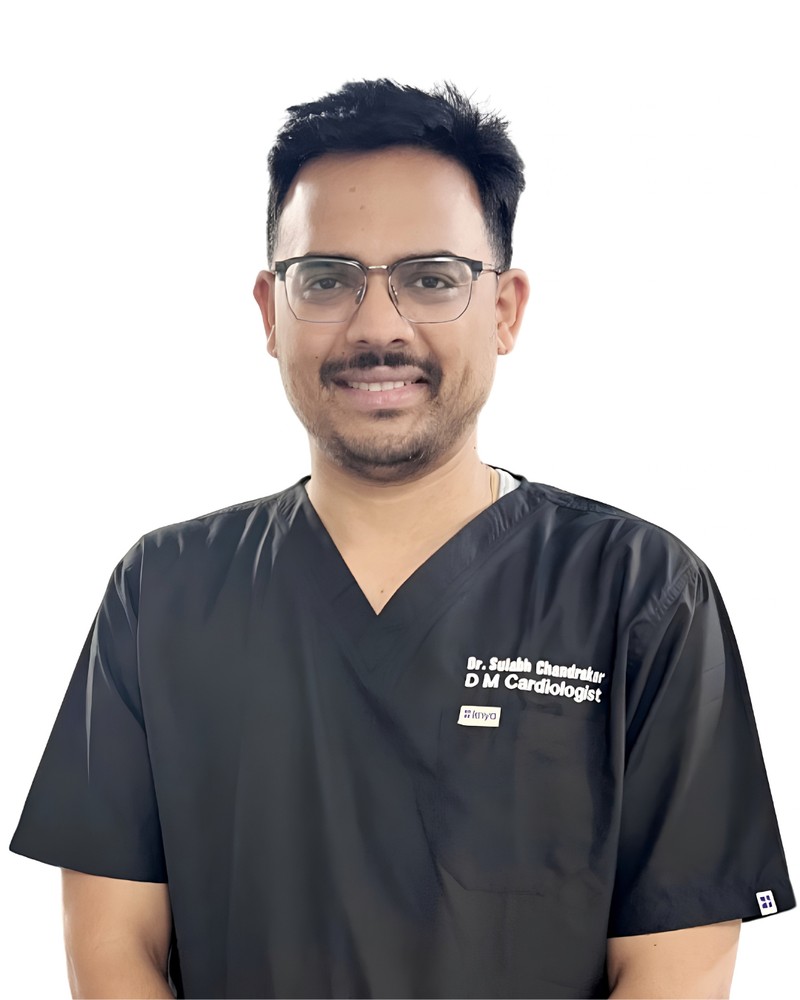
Dr. Sulabh Chandrakar
Manages post-attack care, rhythm problems and the long-term medicines and follow-up that prevent a second event.
Questions Patients Ask Us About This
As soon as possible — ideally within the first hour or two of the pain starting. Heart muscle begins dying early, so the sooner the artery is opened, the more of the heart is saved. Do not wait to see whether the pain settles on its own.
No. It is done through a small puncture at the wrist or groin under local anaesthesia. There is no surgical cut, no general anaesthesia and no ventilator. Most patients are awake and talking throughout.
The only thing most patients feel is the small injection that numbs the skin. There are no pain nerves inside the arteries, so the catheter itself is not painful. A warm flush when the dye is injected is normal.
Usually around three days if there are no complications — the first day in CCU for monitoring, then a day or two in the ward. Your own stay depends on how much heart muscle was affected and how you recover.
For a desk job, commonly around three to four weeks. For heavy physical work it takes longer. Your cardiologist decides this based on your heart function and how your recovery is going.
It can, though modern stents make this much less likely. The two biggest protections are taking your blood-thinning medicines exactly as prescribed and controlling blood pressure, sugar, cholesterol and smoking.
No. Stopping these tablets early is one of the main causes of a stent clotting suddenly, which can be life-threatening. Never stop them on your own — only your cardiologist should change the dose or duration.
If you cannot reach a cath lab quickly, the nearest hospital may give clot-dissolving injections first and then transfer you. This is why it helps to know in advance which hospital near you has 24x7 cardiac facilities.
Not necessarily. In this case one artery was blocked and a stent was enough. Bypass surgery is considered when several arteries are badly blocked or the blockages are not suitable for stenting.