
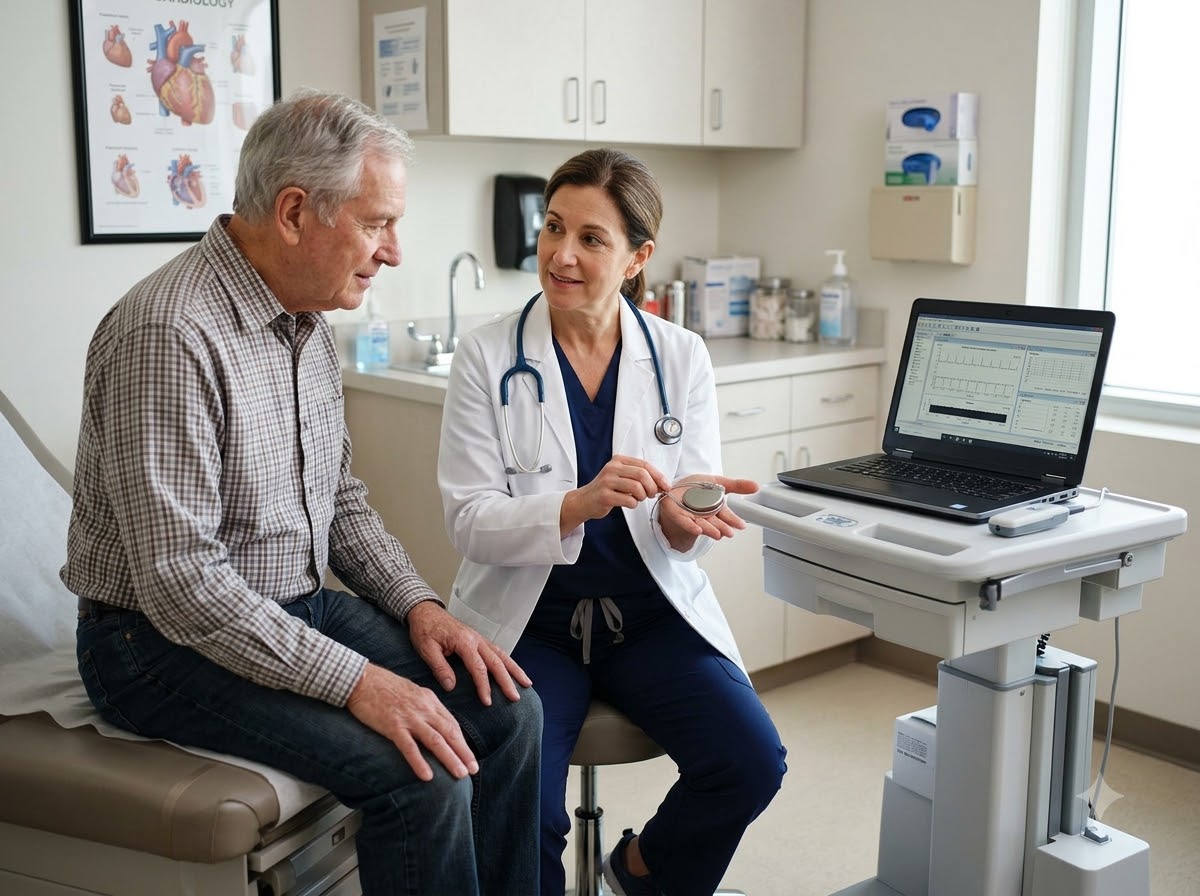
How It Started — and Why It Was Missed for Months
The first episode came in the morning, while he was walking to the market. No chest pain, no warning. He simply felt the world go grey and dropped to the ground. A shopkeeper helped him up. Within a minute or two he was talking normally again, embarrassed more than frightened, and he walked home.
The family decided it was weakness — he had not eaten before leaving, it was hot, perhaps his BP was low or it was a “sugar problem”. He was given juice and told to rest. Over the next three months it happened three more times. The worst was at home: he fell against the edge of a table and cut his eyebrow, which needed stitches at a local clinic.
In between the episodes he felt completely normal. He walked, ate, slept and did his usual work without any difficulty. That is exactly why this was missed for so long. His son finally insisted on seeing a heart specialist, and brought him to us.
The warning signs in his story — and in many others
Please note: This is a representative case, put together from the kind of fainting and heart block we see regularly at our clinic. The details here are illustrative and are not the record of one identifiable patient. Every heart is different, and your own treatment is decided only after your doctor examines you and studies your reports.
What the Tests Showed
Fainting has many possible causes — the heart, the blood pressure, the brain, even simple dehydration. Our job was to find out whether his heart rhythm was behind it. The tests were done in a sensible order, starting with the simplest.
Resting ECG — and why it looked almost normal
An ECG records the heart’s electrical activity for about ten seconds. His was only mildly abnormal. That is not surprising: his problem came and went, and a ten-second recording can easily miss it.
About the ECG testHolter monitoring — the test that caught it
A small recorder worn for 24 hours tracks every single heartbeat while you go about your day. His recording showed long pauses between heartbeats and stretches where the rate fell dangerously low — complete heart block.
About Holter monitoring2D Echo — checking the pump
An ultrasound of the heart to see how well the muscle was squeezing and whether the valves were normal. This tells us whether the slow rhythm is the only problem or there is damage underneath as well.
About 2D EchoRoutine blood tests
Blood sugar, haemoglobin, thyroid, sodium and potassium, and kidney function. These rule out the other common reasons for fainting and for a slow heart rate, including the effect of some medicines.
The most important lesson on this page: a normal ECG does not rule out a rhythm problem. An ECG is a ten-second photograph; a Holter is a day-long video. If you faint and your ECG is reported as normal, that is not the end of the investigation — it is the beginning. Ask your doctor whether a Holter test is needed.
Why a Pacemaker and Not Medicines
His heart’s own natural wiring had failed. The upper chambers were sending signals normally, but those signals were not reaching the lower chambers — that is what complete heart block means. When the beat stopped for a few seconds, blood flow to the brain dropped and he blacked out.
There is no tablet that can reliably repair that wiring. Medicines can speed up a slow heart only briefly and unpredictably, and they do nothing for the pauses. The only dependable answer is a permanent pacemaker — a small device that watches every beat and steps in with a gentle electrical pulse whenever the heart is too slow. The risk of doing nothing was the real decider: the next blackout could have happened on a staircase, on a scooter, or while crossing the road.
Everything was explained to him and his family before consent was taken — what the device does, what it does not do, what could go wrong, and what life with it would look like.
What made a pacemaker the right choice here
- The Holter clearly linked his blackouts to pauses and a very slow rate
- Complete heart block of this kind does not improve on its own
- He had already been injured in one fall — the next one could be far worse
- No reversible cause was found on blood tests or in his medicine list
- His heart muscle and valves were suitable for a simple dual-chamber device
When the plan would have been different
- If a medicine was slowing the heart — stop or change it first and re-check
- If a thyroid or electrolyte problem was the cause — correct that first
- If the slow rate caused no symptoms at all — observation may be enough
- If the fainting came from blood pressure or a fit — a pacemaker would not help
- If there was an active infection anywhere — the implant is postponed until it clears
The Procedure, Step by Step
Families hear the word “implant” and imagine open-heart surgery. It is nothing like that. The chest is never opened, there is no general anaesthesia, and the patient stays awake and talking. Here is exactly how it went.
Preparation in the cath lab
He lay on the table and was connected to monitors. The skin below the left collarbone was cleaned thoroughly and draped. A single antibiotic dose was given. His family waited just outside.
Local anaesthesia only
An injection numbs the skin and tissue below the collarbone. This small sting is the only real discomfort most patients report. He remained awake, could hear the team and could tell them if anything felt uncomfortable.
A small pocket is made
A cut of about four to five centimetres is made and a small space — the “pocket” — is created just under the skin, above the chest muscle. This is where the device will sit.
Two thin leads are placed in the heart
Through a vein under the collarbone, two soft insulated wires are guided into the heart under X-ray guidance — one to the upper chamber, one to the lower. This is not painful; there are no pain nerves inside the veins or the heart.
The leads are tested and the device connected
Each lead is tested to confirm it senses the heartbeat properly and paces reliably. He felt nothing unusual during this. The leads are then fixed and connected to the pacemaker, which is settled into the pocket.
Closing, and the first device check
The skin is closed with stitches and a dressing applied. An X-ray confirms the lead positions, and the device is checked and programmed with a wireless programmer held over the chest. Total time: commonly about an hour to an hour and a half.
What the device actually does, in plain words: it sits quietly and listens to every heartbeat. When your own heart beats properly, the pacemaker does nothing at all. The moment the beat is too slow or a pause begins, it sends a tiny electrical pulse so the heart beats on time. A dual-chamber pacemaker has two leads, so the upper and lower chambers keep beating in the correct order — which feels more natural than pacing the lower chamber alone.
Recovery and Daily Life
This is the part families ask about most. The honest answer is that recovery is mostly about protecting one shoulder for a few weeks.
The same day — monitoring
Back in the ward with rhythm monitoring, sitting up and eating normally within a few hours. Mild soreness around the pocket is expected and is managed with simple painkillers. An overnight stay is the common plan.
Before discharge — wound and device check
The dressing and wound are checked, the device is tested once more, and the settings are confirmed. He was given his pacemaker ID card, the device details in writing, and a clear follow-up date.
Week 1 to 2 — protect the arm
He was told not to raise the left arm above shoulder height, not to lift anything heavy with it, and to keep the dressing dry. Walking, eating, bathing with care and normal household movement were all allowed from day one.
Week 2 to 4 — stitches and settling
Wound review and stitch removal as advised. The soreness fades, the small bulge under the skin becomes something he stops noticing. Light daily activity continues, still no heavy lifting on that side.
About 4 to 6 weeks — back to normal
Full arm movement is usually allowed again, and most people return to their normal routine, including driving once the doctor agrees. His first full device check in the clinic confirmed everything was working as set.
About the battery. A pacemaker runs on a sealed battery that lasts for years — how many depends on the device and on how much pacing your heart actually needs. It is checked at every follow-up, which is exactly why follow-ups matter. The battery does not stop suddenly; the checks show it running low months in advance. When that time comes, only the device is changed in a short procedure — the leads already inside the heart are usually kept.
Everyday life, honestly. He went back to walking, temple visits, travel and his usual food with no restriction. The practical points he was given: hold a mobile phone to the ear on the opposite side, stay away from strong magnets and industrial arc welding, do not lean over a running car engine, and keep the pacemaker ID card in his wallet. Household items — microwave, induction stove, TV remote, Wi-Fi, mixer — are safe.
At airport security, show the card and ask for a hand search instead of walking through repeatedly. For an MRI scan, tell the radiologist you have a pacemaker: it can only be done if your device is MRI-conditional and the scan is supervised with the device programmed for it. Before any surgery, dental procedure or physiotherapy, mention the pacemaker so the team can take the right precautions.
What This Means for You
If you take one thing from this page, take this: fainting is never “just weakness”. A blackout means the brain was briefly starved of blood. Sometimes the reason is harmless. Sometimes, as here, the heart was pausing — and that is a reason to act, not to wait and watch.
This matters even more if it is an elderly parent. Older people often explain away a fall as a slip or carelessness, and families accept it. If your father or mother has had an unexplained fall or blackout, treat it as a medical event:
- Never accept “it was just weakness, low BP or sugar” without tests — get the heart checked
- A single normal ECG is not enough; ask your doctor whether a Holter test is needed
- Do not drive or ride a two-wheeler until the cause of the fainting is found
- Write down each episode — the date, what you were doing, how long it lasted, any warning — this helps the doctor more than you expect
- Carry your full medicine list; some common tablets for BP and heart rate can slow the pulse
- If someone faints and does not wake up quickly, or has chest pain or breathlessness with it, treat it as an emergency
If someone has blacked out and is not responding normally, or has fainted with chest pain or breathlessness, do not wait. Our cardiac emergency is open 24x7 — call +91 77778 65621 or bring them straight in. For repeated fainting that has already settled, book a proper cardiac assessment this week rather than hoping it does not happen again.
Why This Was Possible at Prathmesh
Finding the cause of fainting takes patience and the right tests. Treating it takes a cath lab and a team that does device implants regularly.
DM Cardiology specialists
The consultant who reads your Holter and decides the treatment is the one who performs the implant — the thinking and the hands are the same.
Holter and full rhythm workup
ECG, Holter monitoring, 24-hour BP monitoring and echo are all done in-house, so the cause is chased properly instead of guessed at.
Cath lab with X-ray guidance
Pacemaker leads are placed under live X-ray in a sterile cath lab — the same facility used for our angioplasty work.
Device check before you leave
Every device is tested and programmed before discharge, and checked again at follow-up, with the readings explained to you.
Follow-up you can actually keep
A written follow-up schedule, your device card, and a clinic in Raipur that is easy to return to from Bilaspur, Durg and nearby districts.
Explained in your language
What the device does, what to avoid and what is perfectly safe — explained in Hindi or English, to the patient and the family together.
Who Will Treat You
Your case is handled directly by one of our senior cardiologists, who explains every step before it happens.
800 × 1000 px · JPG

Dr. Gaurav Tripathi
Performs pacemaker and device implantation along with coronary work, and decides device choice and settings for each patient.
800 × 1000 px · JPG
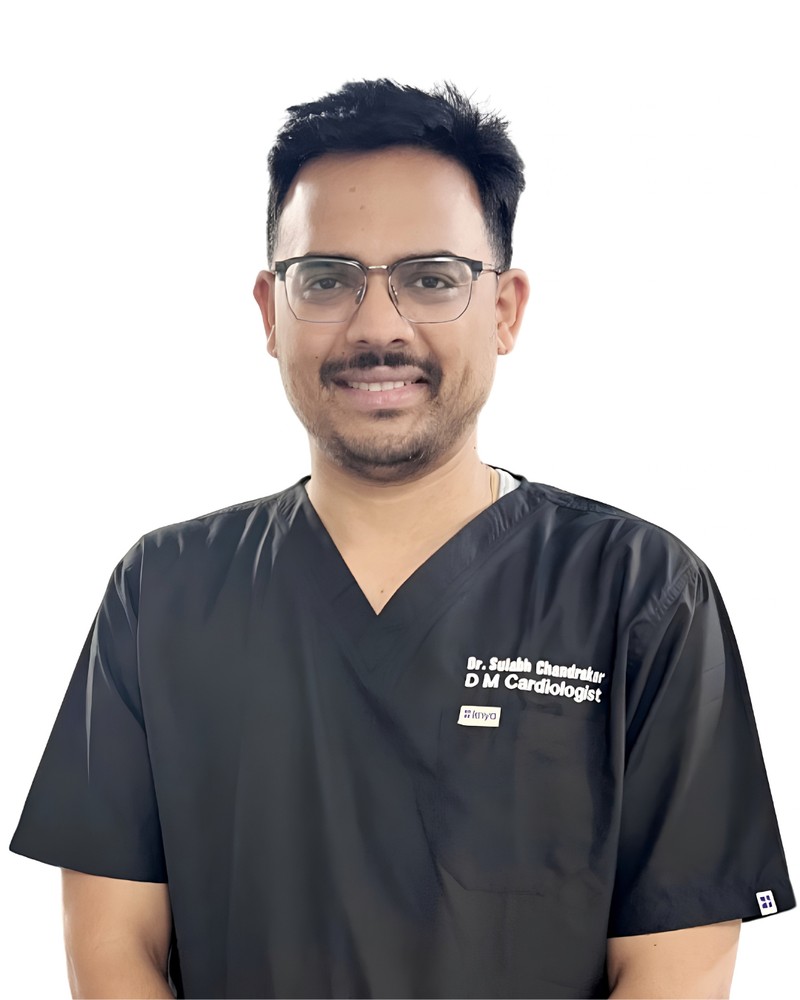
Dr. Sulabh Chandrakar
Investigates fainting and rhythm problems, interprets Holter reports and manages long-term device follow-up and medicines.
Questions Patients Ask Us About This
Yes. An ECG records only about ten seconds of your heartbeat, so a problem that comes and goes can easily be missed. A Holter monitor records every beat for 24 hours or longer and is much more likely to catch it. A normal ECG in someone who has fainted means the investigation should continue, not stop.
It watches your heartbeat continuously and does nothing while your heart is beating properly. If the beat becomes too slow or pauses, it sends a very small electrical pulse so the heart beats on time. It does not take over your heart or stop it from beating on its own.
No. The chest is not opened and general anaesthesia is not used. It is done through a small cut below the collarbone under local anaesthesia, with the patient awake, and commonly takes about an hour to an hour and a half.
There is a small risk of infection or bleeding and bruising at the pocket site, and a lead can occasionally move out of position and need repositioning. Rarely, the lung can be injured while the vein under the collarbone is accessed. Your doctor will go through these with you honestly before you consent.
An overnight stay is the common plan, with the wound and the device checked before discharge. Some patients need longer if there are other medical problems or if the recovery needs watching. Your own stay is decided by your cardiologist.
It lasts for years, and how many depends on the device and on how much pacing your heart needs. It is checked at every follow-up, and the checks show it running low well in advance. When the time comes, usually only the device is replaced in a short procedure and the existing leads are kept.
Yes. Everyday household electronics are safe. The usual advice is to hold the mobile phone to the ear on the side away from the device and not to keep the phone in a shirt pocket right over it. Strong magnets and industrial arc welding should be avoided.
Only if your device is MRI-conditional and the scan is done under supervision with the device programmed for it. Always tell the radiologist and your cardiologist that you have a pacemaker before any MRI is booked. A CT scan, X-ray and ultrasound are not a problem.
Carry your pacemaker ID card and show it to the security staff. Ask for a hand search instead of repeatedly walking through the archway, and do not let a hand-held scanner be held over the device for long. Normal travel, including flying, is otherwise fine.
Most people can go back to driving within a few weeks, but only after your cardiologist agrees, because the arm on that side needs protecting first and the fainting must be fully controlled. Until the cause of your fainting was found and treated, driving was not safe at all.